


















Most extra USPTO trademark fees are avoidable, and they almost always result from preventable mistakes in the application. Understanding how the fee system works can help reduce costs, avoid delays, and improve the chances of successful registration.
USPTO extra fees — key facts
- Additional fees apply per class
- Incomplete applications may trigger a $100 fee
- Free-form descriptions may add $200 per class
- Long custom descriptions may trigger additional charges
- Intent-to-use filings increase total lifecycle cost
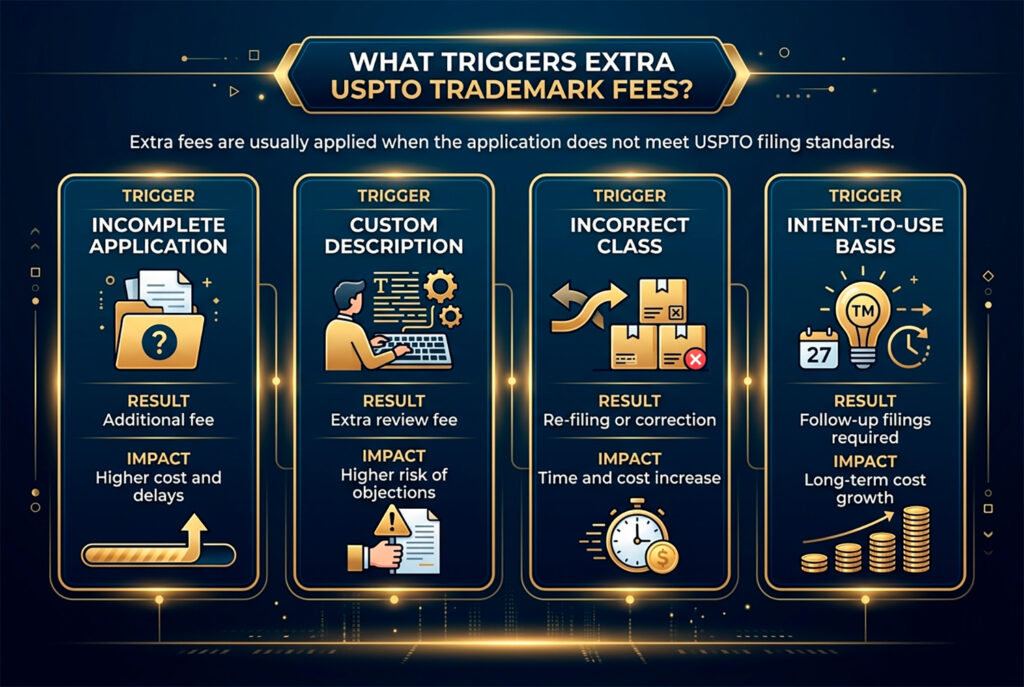
What triggers extra USPTO trademark fees?
Extra fees are usually applied when the application does not meet USPTO filing standards.
| Trigger | Result | Impact |
|---|---|---|
| Incomplete application | Additional fee | Higher cost and delays |
| Custom description | Extra review fee | Higher risk of objections |
| Incorrect class | Re-filing or correction | Time and cost increase |
| Intent-to-use basis | Follow-up filings required | Long-term cost growth |
Why custom descriptions increase costs
Using custom wording instead of the Trademark ID Manual may seem more precise, but it often results in additional fees and longer examination.
In practice, custom descriptions can trigger:
- $200 per class in extra fees
- requests for clarification
- a higher risk of refusal or objection
Should you use custom wording in a trademark application?
In most cases, using standard USPTO descriptions is the better option. However, custom wording may be necessary in some situations.
| Situation | Recommended approach |
|---|---|
| Standard product or service | Use the USPTO ID Manual for lower cost and faster processing |
| Unique or innovative offering | Use custom wording carefully and only when needed |
| Unclear classification | Validate the class strategy before filing to avoid rework |
Using custom wording should be a deliberate decision, not a default choice.
Real-world scenario: how small mistakes increase costs
A founder submits an application with two classes and custom descriptions.
- Base cost: $700
- Custom description fee: $400
- Total: $1,100 before any review issues
If corrections are required, the total cost can increase further due to delays, examiner questions, and additional filings.
Intent-to-use applications and hidden costs
Intent-to-use applications often appear cheaper at first, but they become more expensive over time.
- $150 per class for a Statement of Use
- $125 per class for each extension request
These costs are unavoidable if the trademark is not already in use at the time of filing.
When extra USPTO fees are unavoidable
While most additional fees can be avoided, some costs are unavoidable depending on your situation.
- If your goods or services do not match any existing USPTO ID Manual entry, you may need to use custom wording
- If your business operates across multiple categories, multiple classes are required
- If your trademark is not yet in use, intent-to-use filings will always involve follow-up fees
Understanding which costs are unavoidable helps you plan your budget more accurately and avoid unrealistic expectations.
Real-world scenario: intent-to-use cost escalation
A startup files a trademark before launching its product using an intent-to-use basis.
- Initial filing: $350 per class
- Statement of Use: $150 per class
- Extension requests: $125 per class, if needed
If the launch is delayed, multiple extension requests may be required. As a result, the total cost increases significantly over time.
In practice, applicants who underestimate launch timelines often end up paying more than expected.
How to avoid extra USPTO fees
1. Use the Trademark ID Manual
Standard descriptions are pre-approved and do not trigger additional fees.
2. Submit a complete application
Missing fields often result in extra charges and delays.
3. Choose the correct classes
Incorrect classification may require re-filing or correction.
4. Avoid unnecessary customization
Custom wording should only be used when absolutely necessary.
5. Plan for intent-to-use costs
If you file before launch, budget for later filings such as a Statement of Use and possible extensions.

What happens if you ignore these rules?
Ignoring best practices can lead to:
- higher filing costs
- application delays
- Office Actions
- possible refusal or abandonment
How long do delays typically add to the process?
Errors can extend the trademark process by several months or more, depending on how quickly issues are resolved.
- Office Action response time: 3–6 months
- Additional review cycles: several more months
- Total delay impact: often 6–12 months
Conclusion
Most extra USPTO trademark fees are avoidable. Careful preparation, correct classification, and standardized descriptions can significantly reduce costs and improve the likelihood of successful registration.
Contact Bonamark to ensure your trademark is filed correctly. Our consultants can guide you.
FAQ
Can all extra USPTO fees be avoided?
Most extra fees can be avoided with a complete and properly structured application, although some costs are unavoidable in complex or intent-to-use filings.
What is the most common cause of extra fees?
Custom descriptions and incomplete information are the most common causes.
Is it better to use standard descriptions?
Yes. Standard descriptions usually reduce both cost and risk because they are already recognized by the USPTO.
Do intent-to-use filings always cost more?
Yes, in most cases, they cost more over time because they require additional filings before registration.
Can mistakes delay trademark registration?
Yes. Errors often lead to Office Actions, rework, and longer timelines.
Should you get professional help with a trademark application?
Professional guidance may help reduce filing mistakes, avoid unnecessary fees, and improve application quality.
Can you edit a trademark application after filing?
Some changes are allowed, but major changes may require additional fees or even a new application.
Is it cheaper to fix mistakes or file a new application?
In some cases, re-filing may be more cost-effective than correcting a flawed application, depending on the stage of the process.
Do professional trademark services reduce costs?
Yes. Proper preparation often reduces the risk of errors, additional fees, and delays, which can lower the total cost of registration.
- Trademark registration
- USPTO
- Trademark Fees
- Trademark Filing
Trademark services in the United States


