
















Design Patent Registration

2000
Happy Clients
Over 8000 businesses and entrepreneurs successfully protected their brands using Bonamark.com
180+
Countries
You can protect your trademark in more than 180+ countries in just one place.

24h
Response speed
No more waiting. We value your time and respond within a business day.
23%
Reduced fees
We know that you want to invest your limited resources rationally. We want to make sure that you get the highest return on your investment.
The wondrous world of patents
Welcome to the wondrous world of patents. If you are familiar with patents and patenting, you can skip this part, where I’ll explain what a design patent is and go straight to our services below.
When someone asks about a patent, I will always ask: what kind of patents? Some clients would get surprised: why, there are many types?
Actually, there are at least two internationally recognized types of patents:
- An invention patent.
- A design patent
An invention (utility in the USA) patent is what you would usually call a patent: a type of intellectual property that protects an invention. For example, it protects how a new gadget functions, how a new medicine is being produced and how it treats a certain disease, and how a new material with innovative qualities is manufactured. Also, in some countries it protects software, even certain business processes (the famous buy in one-click of Amazon).
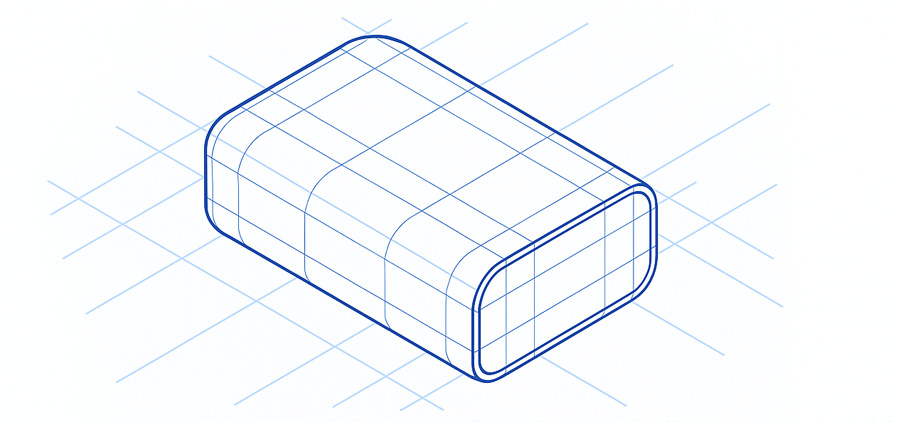
A design patent on the other hand protects only how the product looks. Note, it does not protect how a product functions or its innovative materials, but rather the visual properties of the product. Its color, form, decorations, texture or a combination thereof.
To help distinguish between those types, invention patents are insanely difficult and expensive to register, maintain and enforce. Design patents are just difficult and relatively affordable.
Here, I’ll focus only on design patents.
Design patents
A design patent protects:
- Shape and contours of the product (overall 3D form)
- Surface ornamentation (patterns, textures, decorative elements)
- The configuration of parts as they appear together
- The visual design as registered

To make it clear: if two products have the same functions but look different, they can perfectly coexist from the point of view of the design patent law. The opposite is true as well: if two products look the same, but have different functions, from the point of view of the design patent law they should not coexist, as this will result in a potential infringement. Even if one is a chair and the other one is a pepper mill.
Why register a design patent?
If your product has a unique form, surface pattern, layout, or visual style a design patent will help you protect it from imitators. A design patent is an affordable way to remove imitating products.
What industries register the majority of design patents?
If you work in any of the industries below, you might need a design patent:
This is especially powerful for:
- Tech devices and accessories
- Furniture
- Kitchen products
- Food packaging
- Consumer electronics
- Packaging of cosmetic products
- Fashion items
- Tools and machinery housing
- Retail displays and kiosks
- Etc.
Enforcing a design patent is way easier than a regular patent: if a product looks similar, it infringes upon your patent. This makes it an ideal tool to enforce across multiple marketplaces.
When is the best time to apply for a design patent?
Unlike brands that can survive years of active use without being registered, there is a certain, very specific, timeframe to register a design patent. The general rule: you need to apply for a patent before the visual characteristics of your product are revealed to the public.
There is a grace period in some countries, which is a period after the reveal when you still can apply for your patent. Sometimes it’s 6 months, sometimes it’s 12 months.
But after this period the design becomes unprotectable and anyone can use it.
How to register a design patent?
The process is different in different countries. But there is an international treaty to simplify the process.
Surprise!
Design patents are valid only in the country of registration and you can’t enforce a US patent in the UK and vice versa.
So, how do you register a design patent?
Actually, it’s not as difficult as you might think!
Prepare the images of your products, the name and address of the owner, details of the creator if it’s not the same as the owner and a short description of your product.
That’s basically it!
Yes, in some countries there are specific requirements for how the images should look like, but those are technicalities your attorney can help with.
Eligibility and What Makes a Design Patent Worth It
A design patent must protect something novel and ornamental — meaning it must be a new visual appearance that wasn’t publicly disclosed before filing. Designs that simply result from function rather than appearance typically cannot be protected as design patents.
This focus on visual novelty makes design patents especially valuable if the way your product looks is a key part of its market appeal. Whether it’s the sleek form of a gadget, a distinctive pattern on packaging, or a unique shape of furniture, design patents help you stop imitators who copy the look and feel of your product.
Timeline and Practical Expectations
Generally, the process of examining a design patent application — from filing to grant — can take several months, depending on the country and examination workload. While design patents are typically simpler than utility patents, they still require attention to detail and proper presentation of the design illustrations.
Once granted, a design patent usually provides protection for a defined term (which varies by country), offering you exclusive rights to prevent others from making, selling, or importing products that look substantially similar to your design.
The Hague System
You might ask yourself – what’s the Hague? (System)
That’s a system to simplify design patent registration similar to the one existing for Trademarks called the Madrid System. Both of the systems are managed by an international UN organization WIPO.
Bonamark.com is authorized to file design patents through the Hague System, the International Design System. Using the system, we can register your design in 99 countries, which is usually more cost-effective than using the national systems, as long as you file in several countries simultaneously. You can save up to 50% if you designate 7 countries through the Hague System, instead of filing nationally.
There are certain requirements for filing through the system, but Bonamark® is here to help you to protect your design in the most cost-effective and efficient way possible.
Note: unlike the Madrid System for Trademarks, you don’t need a base design in the Hague System, you can file the first one using the Hague System
Bonamark’s Services for Design Patents
Bonamark Design Patent Service covers more than 50 countries. Through our network of experienced patent attorneys, we can protect your design patents across the globe and provide cost-effective and reliable services for a reasonable fixed fee.
You can find our price list below. Note that prices for some countries are not listed due to complicated price formation process so please inquire if you have requests for those countries.
| COUNTRY | PRICE, USD (with gov. fee) | ADDITIONAL DESIGN, USD |
|---|---|---|
| The Hague System
(99 countries) |
500$ + official fees | 250$ + official fees |
| China | 850 | 390 |
| Australia | Filing: 700 Granting: 520 | 600 |
| Hong Kong | 300 | 230 |
| Taiwan | 860 | – |
| Japan | 1299 | – |
| EU (27 countries) | 990 | 359 |
| South Korea | 1000 | – |
| Canada | 1299 | 799 |
| South Africa | 1099 | 799 |
| UK | 309 | 59 |
| USA | Filing: 750 + government fee (depends on the applicant’s company size) Granting: 425 |
– |
| Malaysia | 874 | 592 |
| Cambodia | Filing: 350 Publication+Registration: 510 | – |
| Vietnam | Filing: 290 Publication+Registration: 205 | 190 |
| Singapore | 600 (per 1 product) | |
| New Zealand | 349 | 249 |
| Kuwait | Please inquire | |
| Qatar | Please inquire | |
| Saudi Arabia | Please inquire | |
| UAE | Please inquire | |
| Oman | Please inquire | |
| Bahrain | Please inquire |
Please note that in many countries a design patent needs to be renewed every year. Make sure that you understand that there will be additional fees associated with renewing your patents.
If you want to protect your design patent anyway in the world, please do not hesitate to contact us at [email protected]
Additionally, Bonamark provides portfolio management services, where we track renewals and other deadlines to make sure that your patents are valid.
Let’s work together to protect your intellectual property internationally!
Contact us
Send us a message

Do you have any questions about designs? Book an appointment with our expert and get a free 20-minute consultation.
Other Bonamark services:
Trademark Search 

We recommend starting with a Trademark Search. A report prepared by our attorneys will help you determine if your trademark can be registered. While this service is optional, our experience shows that clients who begin with a search have the highest probability of successfully registering their mark.
MORE DETAILS >
Trademark Registration

You can focus on your business and we’ll take care of your intellectual property rights for you. When clients choose us they stay for years and return again and again. They work with the same consultant during this time so finally there is someone who truly understands your business and cares about it.
MORE DETAILS >
Trademark Monitoring

When managing an international portfolio of trademarks, it’s important to stay alert for similar marks and actively defend your brand. In some countries, like in the USA, you MUST defend your trademark or you lose your trademark rights. Although WIPO marks have the same legal weight as local marks, enforcing them internationally can be difficult.
MORE DETAILS >