

















Registering a trademark in the United States means filing an application with the United States Patent and Trademark Office, choosing the appropriate filing basis, accurately identifying the goods or services, and showing that the mark functions as a source identifier. A federal registration can protect a business name, logo, slogan, product name, or service mark in connection with the goods or services listed in the registration.
This guide explains when federal registration is useful, who may apply, how trademark searches and filing bases work, what the USPTO examines, how much the process may cost, and what owners must do to maintain a registration after approval.
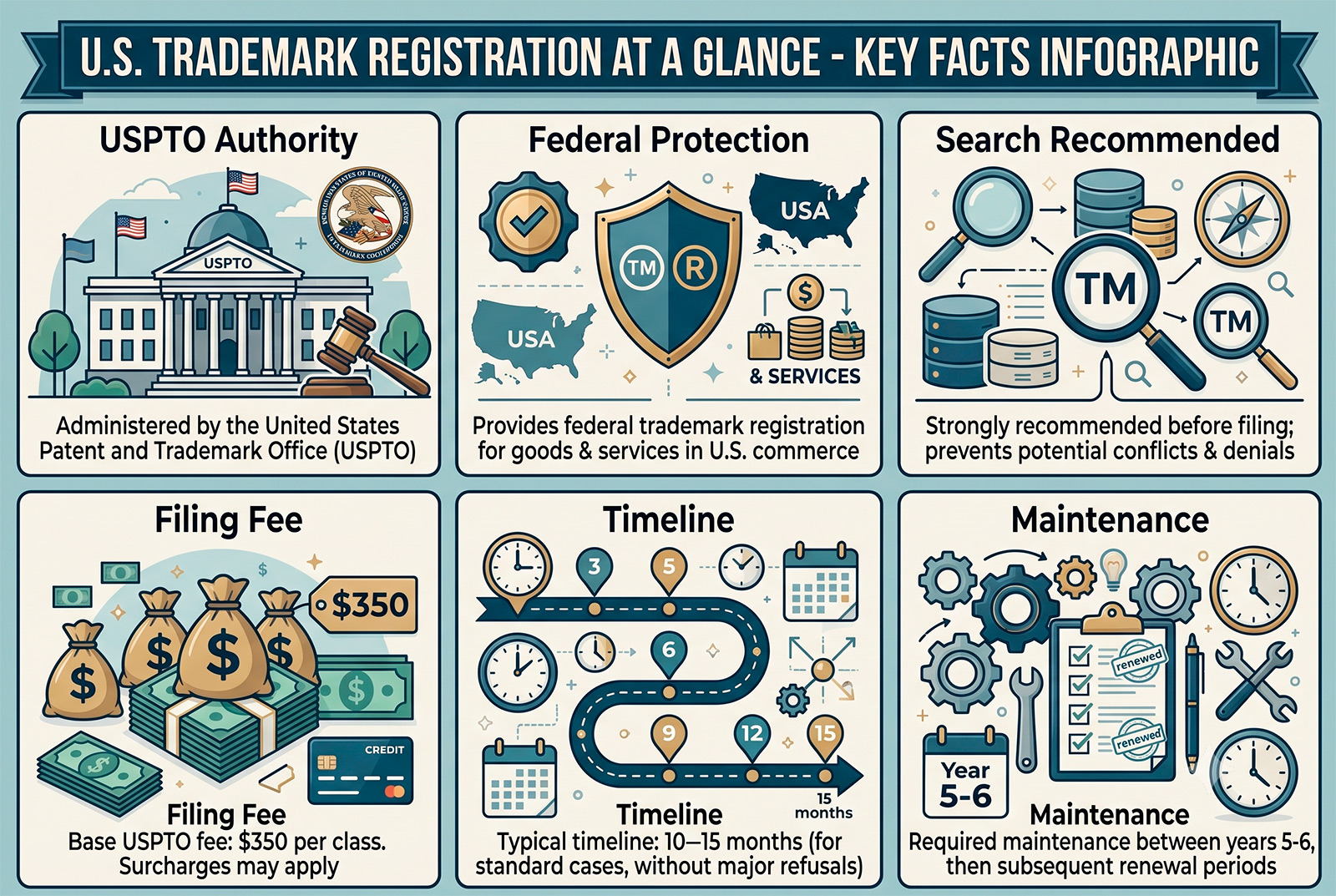
U.S. Trademark Registration at a Glance
| Item | Details |
|---|---|
| Trademark authority | United States Patent and Trademark Office (USPTO) |
| Protection type | Federal trademark registration for goods or services used in U.S. commerce |
| Government filing fee | $350 per class (base USPTO application fee; additional surcharges may apply) |
| Typical timeline | Often about 10–15 months when there are no major refusals, oppositions, or post-filing delays |
| Trademark search | Strongly recommended before filing |
| Foreign applicants | Generally must be represented by a U.S.-licensed attorney |
| Maintenance | Required between years 5–6, then at renewal periods |
Why register a trademark in the United States?
A registered trademark will prevent others from copying your brand and stealing your reputation.
Federal trademark registration gives a brand owner stronger protection than relying only on unregistered use. In the United States, some trademark rights can arise from use in commerce, but those common law rights are usually limited by geography, evidence, and enforcement practicality.
A federal registration can provide several important benefits:
- public notice that the mark is claimed as a trademark;
- legal presumptions of ownership and exclusive rights for the listed goods or services;
- nationwide protection connected to the registered goods or services;
- the ability to use the registration symbol ® after registration;
- a stronger position in enforcement, licensing, and business negotiations;
- support for Amazon Brand Registry and other marketplace brand protection tools;
- and a clearer ownership record for investors, buyers, and partners.
Registration is especially valuable when a business plans to sell online, expand beyond one state, license a brand, raise investment, franchise a concept, sell on Amazon, or build long-term equity around a name or logo.
For businesses that want professional filing help rather than a purely educational overview, Bonamark offers trademark registration support for U.S. and international brand protection strategies.
Who can register a trademark in the United States?
Individuals, companies, partnerships, nonprofits, and foreign businesses may apply for a U.S. trademark if they have a valid basis for filing and the mark is capable of functioning as a trademark.
The application must identify the person or legal entity that owns the trademark. The owner may be an individual, corporation, limited liability company, partnership, or another recognized entity. Incorrect owner information can create serious problems because some ownership errors cannot be corrected after filing.
Foreign-domiciled applicants generally need a U.S.-licensed attorney to represent them before the USPTO. This rule is especially important for international companies that want protection in the United States but do not have a U.S. domicile.
Before filing, businesses should confirm:
- the person or legal entity that owns the mark;
- the exact mark to be protected;
- the goods or services connected with the mark;
- whether the mark is already in use or will be used later;
- whether a U.S. attorney is required;
- and whether a search reveals earlier conflicting marks.
Understanding trademark protection in the United States
Trademark protection in the United States can arise through unregistered use, state registration, or federal registration. These options differ in geographic scope, public record coverage, filing requirements, and enforcement value.
There are three common layers of trademark protection in the United States:
| Protection layer | How it works | Typical limitation |
|---|---|---|
| Common law rights | Rights may arise from actual use of a mark in commerce. | Usually limited to the geographic market where the mark is used and recognized. |
| State trademark registration | A state-level registration creates a state public record. | Protection is generally limited to that state. |
| Federal trademark registration | A USPTO registration can provide nationwide protection for the listed goods or services. | The application must satisfy federal requirements and may be refused if conflicts or legal issues exist. |
For many businesses, federal registration is the strongest option because the internet, e-commerce, marketplace sales, advertising, and interstate services often reach beyond a single local area.
Trademark search before filing
A trademark search should usually happen before filing. The USPTO provides tools to search trademark records, but a useful clearance review should go beyond typing the exact name into a database.
A proper search helps answer practical questions:
- Is the exact mark already taken?
- Are there similar marks with related goods or services?
- Could the USPTO refuse the application based on likelihood of confusion?
- Is the mark too descriptive or generic?
A USPTO database search covers federal applications and registrations, but it does not identify every unregistered user. A broader clearance review may also examine business records, websites, marketplaces, domain names, industry directories, and other evidence of commercial use.
This is where many applicants make a costly mistake. They search only for exact matches, see no identical result, and assume the mark is safe. In trademark law, similar marks can still create risk if the goods or services are related and consumers may believe the brands come from the same source.
Bonamark’s trademark search service can help businesses evaluate conflicts before filing. For a deeper educational explanation of search methodology, see our guide on trademark clearance search.
What can be registered as a trademark?
A trademark can protect a word, phrase, logo, slogan, design, product name, service name, or other source identifier that distinguishes one business from others. The key requirement is that the mark must identify the source of goods or services, not merely describe the product or function as decoration.
Common examples include:
- brand names;
- company names used as brands;
- logos;
- product names;
- service names;
- slogans;
- and some distinctive design elements.
Not every business name is automatically a strong trademark. A name that merely describes what the business sells may be difficult to register. A name that is generic for the product or service usually cannot function as a trademark at all.
Filing bases explained
A U.S. trademark application must include a filing basis. The filing basis tells the USPTO why the applicant is legally allowed to seek registration.
Use in commerce
Use in commerce means the mark is already being used in U.S. commerce with the listed goods or services. For goods, this often involves use on labels, packaging, tags, or product pages where the mark appears near the product and the product can be purchased. For services, this often involves use in advertising, websites, brochures, or service materials that connect the mark with the offered services.
Applicants filing based on use in commerce must usually submit a specimen showing real use of the mark. If the specimen is weak, outdated, or does not show trademark use, the USPTO may refuse it.
Intent to use
An Intent-to-Use application lets an applicant file before actual use begins, as long as the applicant has a bona fide intention to use the mark in commerce. This can help secure an earlier filing date while the brand is still preparing to launch.
However, an Intent-to-Use application will not become a registration until the applicant later proves actual use. For more detail, see our guide to Intent-to-Use trademark applications.
Foreign application or foreign registration basis
Some foreign applicants may rely on a foreign application or foreign registration as a filing basis. These options are especially relevant for international businesses that already filed or registered the mark outside the United States and want to extend protection into the U.S. market.
Foreign filing strategies should be reviewed carefully because the U.S. still applies its own examination rules. A mark accepted in another country may still face issues in the United States.
Step-by-step U.S. trademark registration process
The USPTO’s trademark application process includes several stages. The exact path depends on the filing basis, whether the USPTO issues an Office Action, whether an opposition is filed, and whether the applicant must submit a Statement of Use.
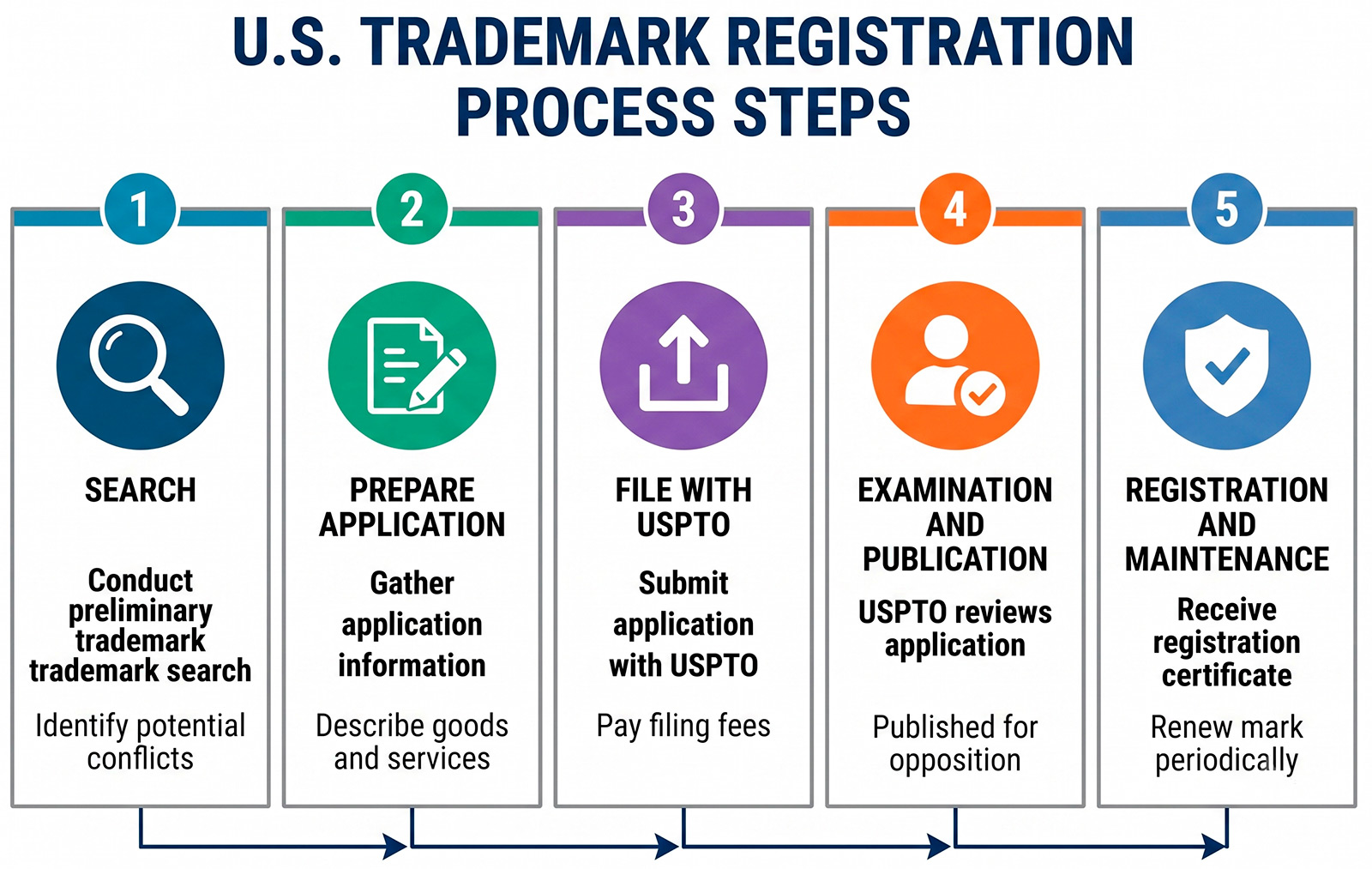
Step 1: Conduct a trademark search
Before filing, the applicant should search for identical and similar marks. This step helps assess whether the mark is likely to face a conflict. A search is not a guarantee of approval, but it can help avoid preventable refusals and rebranding costs.
Step 2: Identify the correct owner
The application should be filed by the person or legal entity that owns the mark. This is especially important for startups, founders, holding companies, and businesses that recently changed names or ownership.
Step 3: Choose the mark format
Applicants may file for a standard character mark, a design mark, or another mark format. A standard character mark protects the wording itself, while a design mark protects a particular visual presentation. The right format depends on how the brand is used and what protection the applicant needs.
Step 4: Select goods and services
Trademark protection is tied to specific goods or services. The applicant must describe them accurately and classify them correctly. Overly broad, inaccurate, or unclear descriptions can create delays, extra fees, or weaker protection.
Step 5: Choose the filing basis
The applicant must decide whether the application is based on current use, intent to use, a foreign application, a foreign registration, or another permitted basis. This decision affects whether a specimen is required at filing and what steps may be needed later.
Step 6: File the application
After the application is prepared, it is submitted electronically. Filing fees are generally charged per class. The application then enters the USPTO review process.
Step 7: USPTO examination
A USPTO examining attorney reviews the application. The examiner may check for conflicts, descriptiveness, genericness, specimen issues, classification problems, disclaimers, ownership issues, and other requirements.
Step 8: Respond to Office Actions if needed
If the USPTO raises issues, it may issue an Office Action. Some Office Actions involve technical corrections. Others involve serious refusals such as likelihood of confusion or descriptiveness. A timely and well-supported response is often required to keep the application alive.
Step 9: Publication for opposition
If the application is approved by the examining attorney, it is published for opposition. During the opposition period, third parties may object if they believe registration would harm their rights.
Step 10: Registration or Notice of Allowance
If no opposition blocks the application, a use-based application may proceed to registration. If the application was filed based on intent to use, the USPTO may issue a Notice of Allowance, and the applicant must later submit proof of use.
How long does it take to register a trademark in the United States?
Many U.S. trademark applications take about 10–15 months when there are no major refusals, oppositions, or delays. Some applications move faster. Others take longer, especially if the USPTO issues an Office Action, the applicant files under Intent-to-Use, or a third party opposes the application.
| Stage | What happens | Timing factor |
|---|---|---|
| Initial filing | Application is submitted to the USPTO. | From several days to several weeks. |
| USPTO examination | Examining attorney reviews the application. | 6–8 months. |
| Office Action response | Applicant responds if issues are raised. | Can add several months or more. |
| Publication | Third parties have a chance to oppose. | Usually includes a 30-day opposition period. |
| Statement of Use | Required for Intent-to-Use applications before registration. | 6 months from the approval date. |
How much does U.S. trademark registration cost?
Trademark registration costs include government fees and, in many cases, professional assistance. USPTO filing fees are generally charged per class. For federal applications, Bonamark uses the current practical range of $650–$850 per class, depending on filing requirements and application details.
| Cost item | What it covers | Important note |
|---|---|---|
| $350 per class | USPTO base application fee. | Additional USPTO surcharges may apply in specific cases. |
| $130 per class | Conflict review before filing. | Can reduce risk before application fees are spent. |
| $300 per class | Application strategy, drafting, classification, and review. | Varies by provider and complexity. |
| $420 per class | Proof of use after an Intent-to-Use application is allowed. | Can add post-filing cost. |
| $300–700 | Response to USPTO objections or refusals. | Cost depends on the issue. |
Applicants should confirm current government fees before filing because USPTO fees can change. The final cost depends on the number of classes, filing basis, quality of the application, and whether any issues arise after submission.
Common reasons U.S. trademark applications fail
Many trademark applications fail or become delayed because of issues that could have been identified before filing. The most common problems include conflicts, weak marks, unclear descriptions, specimen issues, and missed deadlines.
| Issue | What can happen | How to reduce risk |
|---|---|---|
| Likelihood of confusion | The USPTO refuses the application because a similar mark exists for related goods or services. | Conduct a clearance search before filing. |
| Descriptiveness | The mark is refused because it describes the goods or services too directly. | Choose a distinctive mark and assess registrability early. |
| Weak specimen | The USPTO refuses the proof of use. | Use a specimen that shows real trademark use in commerce. |
| Incorrect goods or services | The application may face delays or protection gaps. | Draft accurate descriptions and choose the correct classes. |
| Missed deadlines | The application may become abandoned. | Track USPTO deadlines carefully. |
For one of the most common refusal risks, see our guide on likelihood of confusion in trademark law.
Intent-to-Use applications and Statement of Use
An Intent-to-Use application is useful when a business has not yet launched but wants to reserve priority for a mark it genuinely plans to use. This can be important for startups, product launches, rebrands, and companies preparing packaging or marketplace listings.
The key point is that an Intent-to-Use application does not become a registration until the applicant proves actual use. After the USPTO approves the application and issues a Notice of Allowance, the applicant must submit a Statement of Use or request an extension.
A Statement of Use shows that the mark is now being used in commerce with the goods or services listed in the application. It usually includes a specimen and a government fee. If the applicant cannot show use by the deadline and does not obtain available extensions, the application may be abandoned.
Trademark specimens
A specimen is proof that the trademark is actually used in business. For goods, a specimen may include a label, packaging, tag, product photo, or e-commerce product page showing the mark near the goods. For services, a specimen may include a website, advertisement, brochure, or other material showing the mark used in connection with the services.
Specimen problems are common because applicants often submit materials that show a logo or name but not real trademark use. A mockup, decorative use, invoice, business card, or incomplete screenshot may not be acceptable depending on the filing context.
Before filing, review our guide to acceptable trademark specimens for goods and services. If a specimen has already been refused, see our article on common specimen refusals and how to avoid them.
Office Actions and refusals
An Office Action is an official USPTO letter that raises issues with an application. The USPTO provides guidance on how applicants can respond to an Office Action, but the best response depends on the specific refusal or requirement.
Office Actions may involve:
- likelihood of confusion;
- descriptiveness;
- genericness;
- specimen refusal;
- identification of goods or services issues;
- disclaimer requirements;
- ownership or entity issues;
- or procedural corrections.
Some Office Actions are straightforward. Others require legal argument, evidence, amended descriptions, substitute specimens, or strategic decisions about whether to continue. Missing the response deadline can cause the application to abandon.
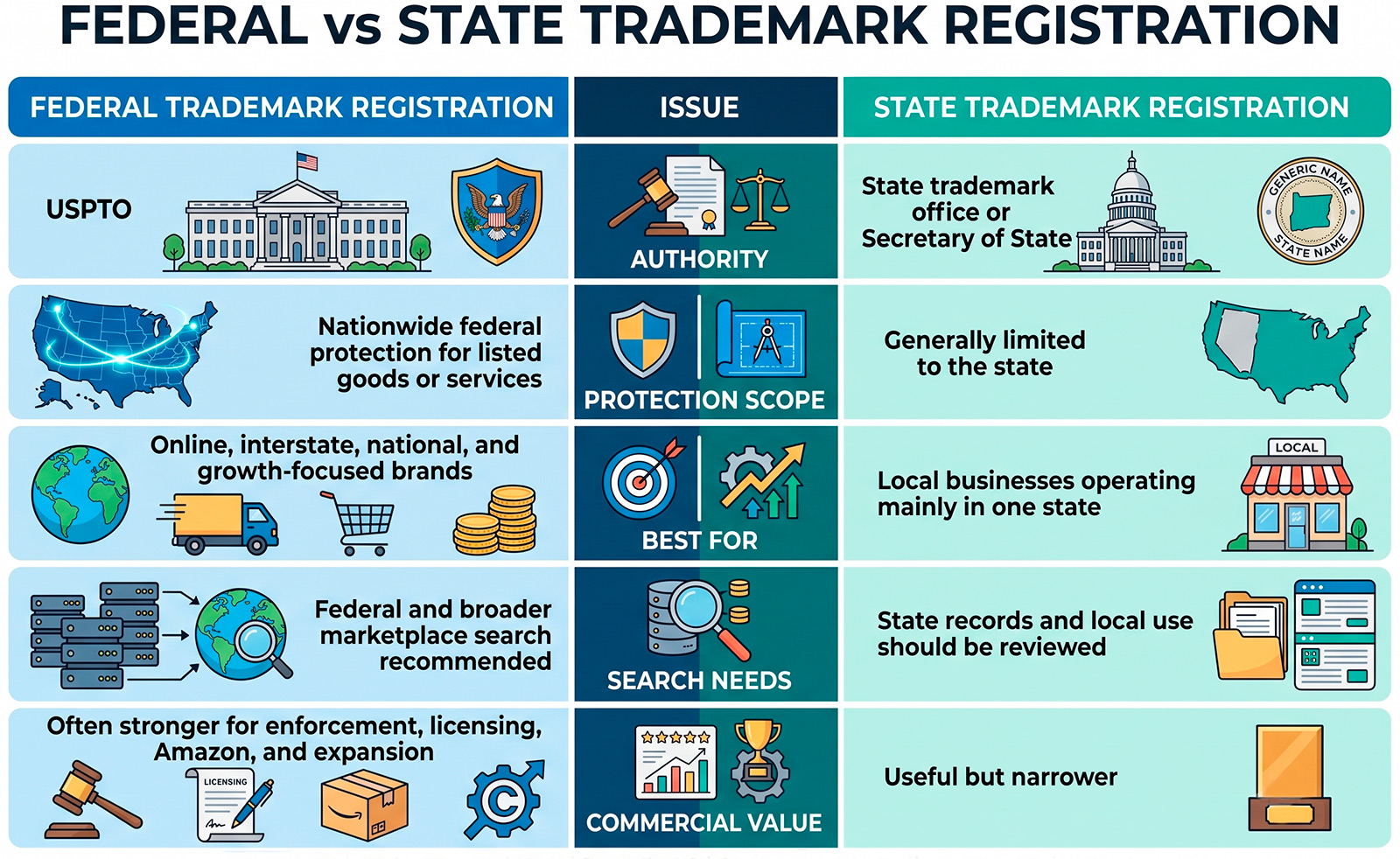
Federal vs state trademark registration
Federal and state trademark registration are different tools. A state registration may be useful for a local business operating only within one state, while federal registration is usually more valuable for businesses that sell online, ship across state lines, advertise nationally, franchise, license, or plan to expand.
| Issue | Federal trademark registration | State trademark registration |
|---|---|---|
| Authority | USPTO | State trademark office or Secretary of State |
| Protection scope | Nationwide federal protection for listed goods or services | Generally limited to the state |
| Best for | Online, interstate, national, and growth-focused brands | Local businesses operating mainly in one state |
| Search needs | Federal and broader marketplace search recommended | State records and local use should be reviewed |
| Commercial value | Often stronger for enforcement, licensing, Amazon, and expansion | Useful but narrower |
Bonamark has also prepared state-level trademark registration guides for businesses that want to understand state requirements before choosing a filing strategy.
International applicants and Madrid filings
Foreign applicants often use direct U.S. filing or the Madrid System to seek U.S. protection. The right route depends on the applicant’s home filing, target markets, goods and services, budget, and risk tolerance.
A Madrid filing can be efficient for some international portfolios, but it is not always the best choice. Direct U.S. filing may offer more flexibility in descriptions and strategy. For a deeper comparison, see our guide on Madrid vs national trademark filing.
Trademark maintenance and renewals
Registration is not the end of the process. U.S. trademark owners must keep using the mark and file maintenance documents at required intervals. The USPTO provides online trademark maintenance forms for post-registration filings.
The first major maintenance filing is usually due between the fifth and sixth year after registration. Later filings are due around the tenth year and then in later renewal periods. If required maintenance filings are missed, the registration may be canceled or expire.
Maintenance review should confirm:
- the mark is still in use;
- the listed goods or services are still accurate;
- the owner record is correct;
- the specimen reflects current use;
- and deadlines are tracked.
For more detail, see our guide on how to keep a U.S. trademark alive. Businesses with valuable brands should also consider trademark monitoring to identify new conflicts after registration.
Related Bonamark resources
This U.S. trademark registration guide connects to several practical resources that can help at different stages of the filing journey:
- Trademark Search Service — for conflict review before filing.
- Trademark Registration Service — for filing strategy and application support.
- Trademark Clearance Search Guide — for understanding how professional searches work.
- Intent-to-Use Trademark Application — for pre-launch brands.
- What Is a Statement of Use? — for post-allowance proof of use.
- Acceptable Trademark Specimens — for proof of use examples.
- Common Specimen Refusals — for avoiding proof-of-use problems.
- Likelihood of Confusion — for one of the most common USPTO refusal risks.
- Madrid vs National Filing — for international filing strategy.
Final thoughts
Registering a trademark in the United States can be one of the most important legal steps in building a brand. The process is not only about submitting a form. It requires a clear mark, an accurate goods and services description, a valid filing basis, a strong specimen when required, and a strategy for dealing with USPTO examination risks.
A search before filing can reduce avoidable conflicts. A carefully prepared application can reduce delay. Proper maintenance can keep the registration active after approval. Together, these steps help turn a brand name or logo into a stronger business asset.
Contact Bonamark to ensure your trademark is filed correctly. Our consultants can guide you through trademark search, filing strategy, registration, monitoring, and long-term protection in the United States.
Frequently Asked Questions
How much does trademark registration cost in the United States?
The base USPTO application fee is $350 per class. For federal applications, Bonamark typically uses a practical total range of $650–$850 per class, depending on filing requirements and application details. This amount generally includes the USPTO filing fee and Bonamark's professional filing support. Additional costs may apply for services such as a trademark search, Statement of Use filings, Office Action responses, or future maintenance filings.
How long does it take to register a trademark in the United States?
Many applications take about 10–15 months when there are no major refusals, oppositions, or post-filing delays. Intent-to-Use applications and applications with Office Actions may take longer.
Do I need a trademark search before filing?
A trademark search is strongly recommended before filing. It helps identify similar marks, conflicts, and filing risks before government fees and branding investments are spent.
Can a foreign company register a U.S. trademark?
Yes. Foreign companies can register U.S. trademarks, but foreign-domiciled applicants generally need representation by a U.S.-licensed attorney before the USPTO.
What is the difference between Use in Commerce and Intent to Use?
Use in Commerce applies when the mark is already being used in U.S. commerce. Intent to Use applies when the applicant has a real plan to use the mark later but has not started use yet.
What is a Statement of Use?
A Statement of Use is a filing that shows the USPTO an Intent-to-Use mark is now being used in commerce. It usually includes a specimen and a government fee.
What happens if the USPTO refuses my trademark application?
The USPTO may issue an Office Action explaining the issue. The applicant must respond by the deadline. Some refusals can be overcome, while others may require a change in strategy.
How long does a U.S. trademark registration last?
A U.S. trademark registration can last indefinitely if the owner continues using the mark and files all required maintenance and renewal documents on time.
Is federal trademark registration better than state registration?
Federal registration is usually stronger for online, interstate, national, or growth-focused businesses. State registration may be useful for local businesses operating mainly within one state.
Can Bonamark help file a U.S. trademark application?
Yes. Bonamark can help with trademark search, filing strategy, application preparation, monitoring, renewal planning, and international trademark protection.
- Trademark registration
- USPTO
- Trademark Filing
- Trademark Search
- U.S. Trademark
Trademark services in the United States


