


















Filing a trademark application based on intent to use allows businesses to reserve rights in a brand before commercial launch. However, the application process does not end once the USPTO approves the mark for publication.
If you filed an intent-to-use application under Section 1(b), the USPTO will eventually require proof that the trademark is actually being used in commerce. This is where the Statement of Use becomes critical.
A Statement of Use (SOU) confirms that the trademark is actively used in connection with the goods or services listed in the application. Without a properly filed SOU, the application cannot proceed to registration.
For founders, e-commerce businesses, SaaS companies, product launches, and expanding brands, understanding SOU deadlines and filing requirements is important because missing a deadline or submitting an incorrect specimen can delay or even abandon the application.
What Is a Statement of Use?
A Statement of Use is a filing submitted to the USPTO after a Notice of Allowance is issued for an intent-to-use trademark application.
The filing includes:
- confirmation that the trademark is in commercial use,
- the date of first use,
- the date of first use in interstate commerce,
- a specimen showing actual trademark use,
- government filing fees.
The USPTO reviews the Statement of Use to verify that the trademark is genuinely used in commerce and not merely reserved without active business activity.
In practice, the SOU acts as the final proof that the brand moved from planning stage to real commercial use.
When Do You Need to File a Statement of Use?
A Statement of Use is only required for trademark applications filed on an intent-to-use basis under Section 1(b).
If the original application was filed based on actual use in commerce under Section 1(a), no SOU is required because proof of use was already provided during filing.
The USPTO issues a Notice of Allowance after:
- the trademark application passes examination,
- the mark is published for opposition,
- no successful opposition is filed.
Once the Notice of Allowance is issued, the applicant has six months to either:
- file the Statement of Use, or
- request an extension of time.
For a more detailed explanation of filing requirements, specimens, deadlines, extensions, and common Statement of Use mistakes, see our complete Statement of Use trademark guide.
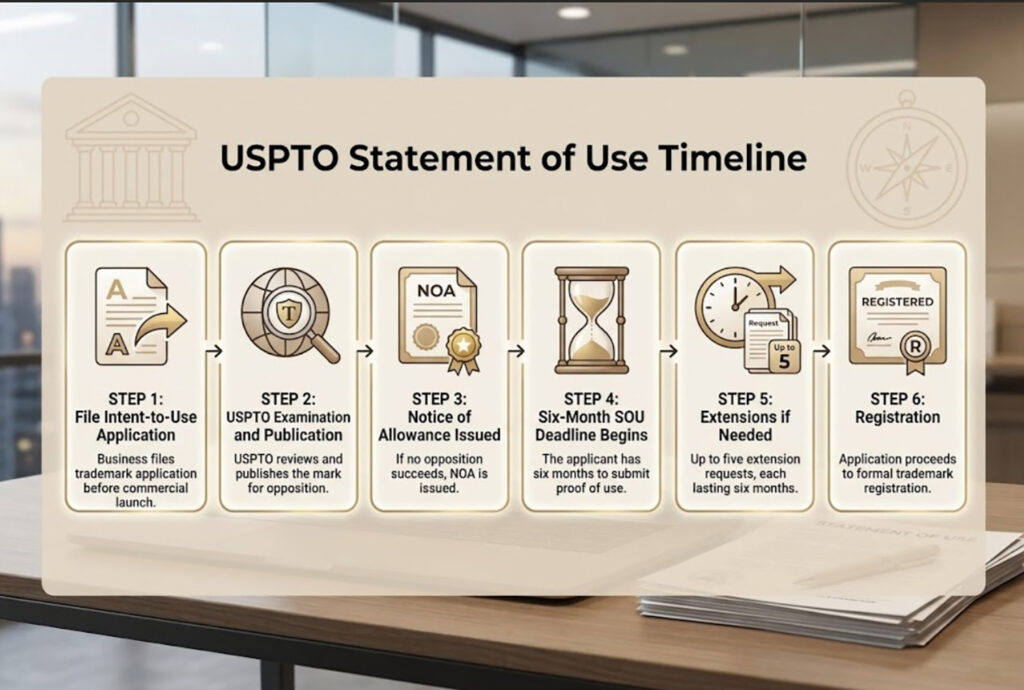
USPTO Statement of Use Timeline
The SOU process follows a strict timeline.
Step 1 — File an Intent-to-Use Application
The business files a trademark application before commercial launch.
Step 2 — USPTO Examination and Publication
The USPTO reviews the application and publishes the mark for opposition.
Step 3 — Notice of Allowance Issued
If no opposition succeeds, the USPTO issues a Notice of Allowance.
Step 4 — Six-Month SOU Deadline Begins
The applicant now has six months to submit proof of use.
Step 5 — Extensions if Needed
If the mark is not yet used in commerce, extension requests may be filed.
The USPTO allows up to five extension requests, each lasting six months.
Step 6 — Registration
Once the Statement of Use is accepted, the USPTO proceeds toward registration.
How Much Does a Statement of Use Cost?
USPTO fees for a Statement of Use are charged per class.
At the time of writing, the standard USPTO filing fee for a Statement of Use is typically:
- approximately 420$ with attorney fees,
- additional fees for extension requests,
- possible attorney fees if professional assistance is used.
Businesses with multiple trademark classes should calculate filing costs carefully because each class requires separate fees and supporting proof.
For example:
| Number of Classes | Estimated USPTO SOU Filing Fees |
|---|---|
| 1 class | About $150 |
| 2 classes | About $300 |
| 3 classes | About $450 |
Additional legal review may be worthwhile because specimen refusals and filing errors can create larger costs later.
What Counts as Acceptable Trademark Use?
The USPTO requires actual use in commerce.
This generally means:
- products are sold or transported in interstate commerce, or
- services are actively offered to customers across state lines.
Merely reserving a domain name, creating a logo, or planning a launch is usually insufficient.
The use must be genuine commercial trademark use.
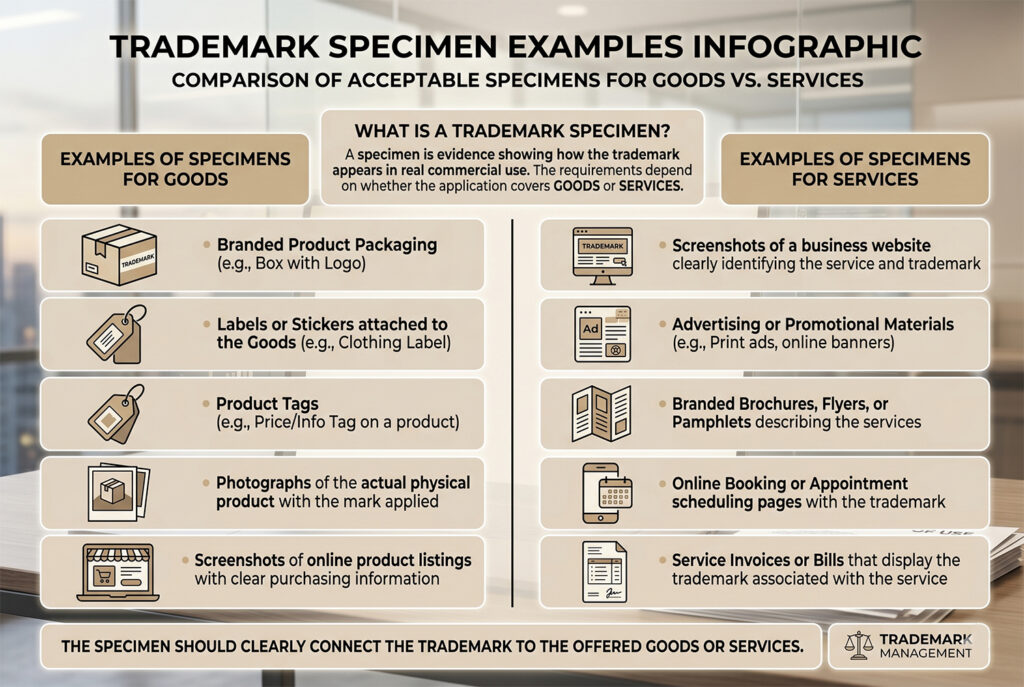
What Is a Trademark Specimen?
A specimen is evidence showing how the trademark appears in real commercial use.
The specimen requirements depend on whether the application covers goods or services.
Examples of Specimens for Goods
Acceptable specimens for goods may include:
- product packaging,
- labels,
- tags,
- product photographs,
- screenshots of online product listings with purchasing information.
Examples of Specimens for Services
Acceptable specimens for services may include:
- website screenshots,
- advertising materials,
- brochures,
- online booking pages,
- service invoices.
The specimen should clearly connect the trademark to the offered goods or services.
Common Statement of Use Mistakes
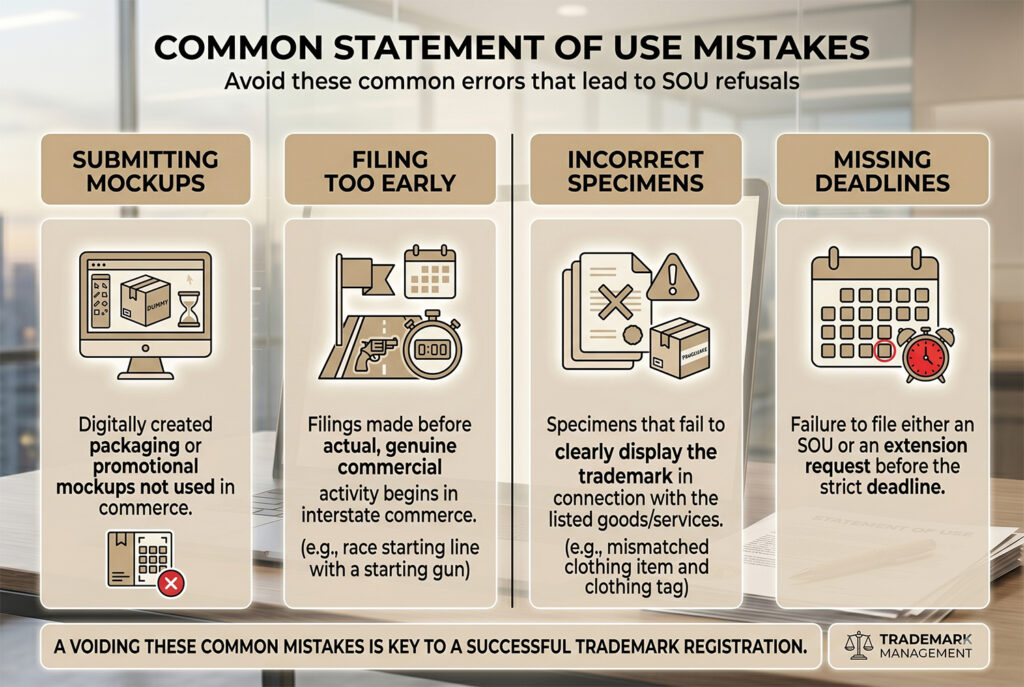
Many SOU refusals happen because applicants misunderstand what the USPTO expects.
Submitting Mockups Instead of Real Use
Digitally created packaging or promotional mockups that are not actually used in commerce may be rejected.
Filing Too Early
Some applicants file before real commercial activity begins.
The USPTO may reject filings that lack genuine interstate commerce use.
Incorrect Specimens
Specimens that do not clearly display the trademark in connection with the listed goods or services can create refusals.
Missing Deadlines
Failure to file either an SOU or extension request before the deadline may result in application abandonment.
Overly Broad Goods and Services
If the listed goods or services are broader than the actual commercial use, the applicant may need to narrow the application.
What Happens If You Miss the Statement of Use Deadline?
Missing the SOU deadline can lead to abandonment of the trademark application.
In some situations, revival options may exist, but they can increase costs and delay registration.
For growing businesses, abandoned intent-to-use applications may also create branding risks if competitors file similar marks during the delay.
Monitoring deadlines carefully is therefore essential.
Can You Extend the Statement of Use Deadline?
Yes.
If the trademark is not yet in commercial use, applicants may request extensions.
The USPTO generally allows:
- one initial six-month SOU period,
- up to five six-month extension requests.
This creates a maximum possible timeline of approximately three years after the Notice of Allowance.
Extension requests require a verified statement confirming ongoing bona fide intent to use the mark in commerce.
Statement of Use vs Amendment to Allege Use
Applicants sometimes confuse a Statement of Use with an Amendment to Allege Use.
The difference mainly depends on timing.
| Filing Type | When Used |
|---|---|
| Amendment to Allege Use | Before publication or before Notice of Allowance |
| Statement of Use | After Notice of Allowance |
Both filings require specimens and proof of use.
Why Trademark Search Still Matters Before Filing
Even though the Statement of Use happens later in the application process, trademark search remains critical at the beginning.
Filing an intent-to-use application without reviewing earlier marks can create serious risks:
- USPTO refusals,
- oppositions,
- branding conflicts,
- forced rebranding,
- marketplace disputes.
A professional trademark search can help identify conflicting marks before businesses invest in product launches, packaging, websites, advertising, and inventory.
Businesses planning US trademark protection often combine:
- trademark search,
- filing strategy,
- class review,
- specimen preparation,
- Statement of Use guidance.
How Bonamark Can Help
Preparing a Statement of Use involves more than uploading a screenshot.
Applicants must ensure:
- the trademark is genuinely used in commerce,
- specimens meet USPTO standards,
- goods and services match actual use,
- deadlines are monitored correctly,
- filing strategy aligns with long-term brand protection.
Bonamark can help businesses review trademark use evidence, prepare SOU filings, evaluate specimens, and reduce the risk of avoidable USPTO refusals.
FAQ
What is a Statement of Use in trademark law?
A Statement of Use is a USPTO filing confirming that a trademark filed on an intent-to-use basis is now actively used in commerce.
When must a Statement of Use be filed?
The Statement of Use must generally be filed within six months after the USPTO issues a Notice of Allowance.
How much does a Statement of Use cost?
USPTO SOU filing fees are typically charged per class and are commonly around $100 per class, excluding extension or attorney fees.
What happens if I miss the SOU deadline?
Missing the deadline may cause the trademark application to become abandoned unless revival options are available.
Can I file a Statement of Use without selling products yet?
No. The USPTO requires actual commercial use in commerce before accepting a Statement of Use.
What is an acceptable trademark specimen?
Acceptable specimens may include packaging, labels, website screenshots, product pages, advertisements, or other materials showing real trademark use in commerce.
- Trademark registration
- USPTO
- Trademark Filing
- Intent-to-Use
- Statement of Use
Trademark services in the United States


