













If you do business in North Carolina and want to protect a brand name, logo, or slogan within the state, a North Carolina state trademark can be an effective and relatively affordable way to secure your rights locally. It does not replace a federal registration, but it helps you prove ownership in North Carolina and enforce your mark against confusingly similar uses.
This guide explains how to register and maintain a state trademark with the North Carolina Secretary of State – Trademark Registration Office and when it makes sense to move to a federal registration with the USPTO instead.
Key Facts
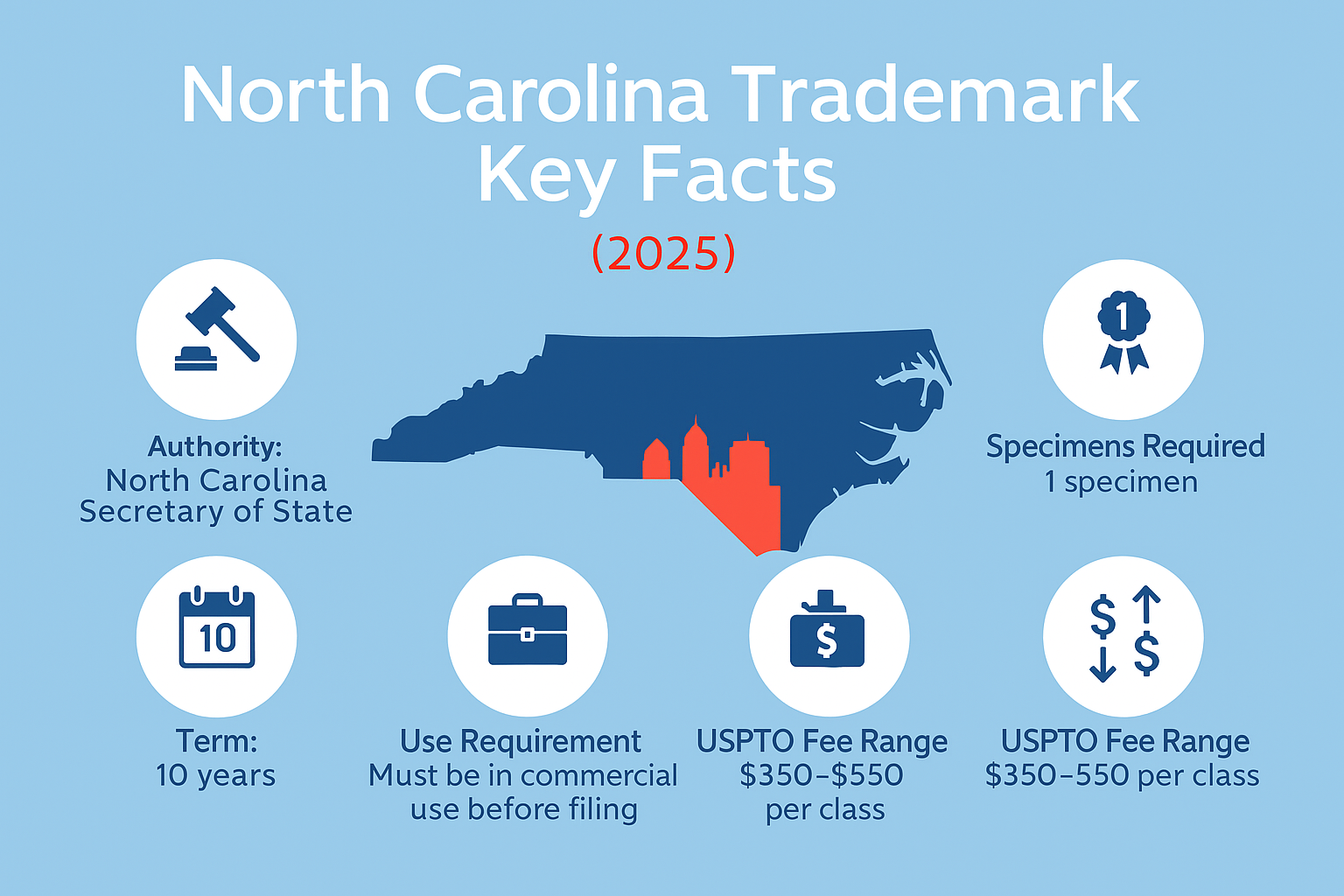
- Authority: North Carolina Secretary of State, Trademark Registration Office.
- Application form: Form TM-01 – Application for Registration or Renewal of Trademark or Service Mark.
- Filing fee: USD $75 per application per class (non-refundable).
- Specimens: Three original specimens of the mark as actually used in commerce in North Carolina.
- Term: 10-year registration term, renewable for additional 10-year periods.
- Maintenance: Affidavit of Use and specimen due between the 5th and 6th year or the registration may be cancelled.
- Scope: Protection only within North Carolina. For nationwide protection, a federal USPTO registration is recommended (base application fee typically around $350 per class, with possible surcharges that can increase the cost).
If your business already sells or plans to sell across several states, consider a federal U.S. trademark registration instead of, or in addition to, a North Carolina state filing.
What is a North Carolina state trademark?
A North Carolina state trademark is a mark (word, logo, slogan or combination) registered with the North Carolina Secretary of State and protected only within the state. Registration:
- confirms that you are the owner of the mark for specific goods or services in North Carolina,
- provides a public record of your rights,
- strengthens your position when sending cease-and-desist letters or taking action in state courts.
It does not automatically give you rights in other states. For broader protection, you need a federal trademark registration with the USPTO.
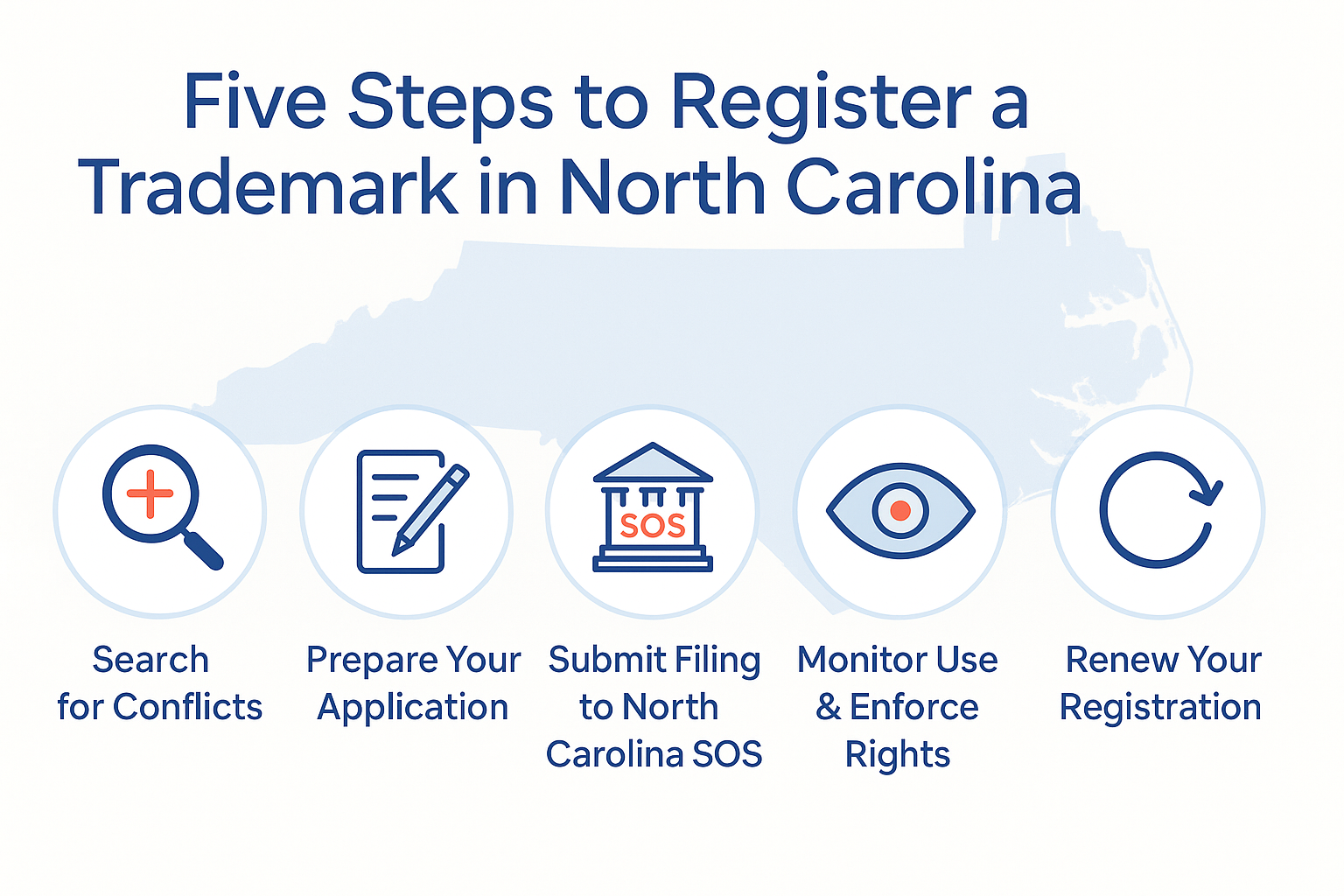
Step 1: Search existing trademarks in North Carolina
Before you file an application, check whether your desired mark (or something similar) is already in use or registered.
- Search the North Carolina trademark database
The Secretary of State provides an online search for state trademark and service mark registrations. Search for:- exact matches,
- similar spellings and phonetic equivalents,
- shortened versions, abbreviations and acronyms,
- translations or alternative wordings.
- Check beyond the state registry
Even if the North Carolina database is clear, you should search:- USPTO TESS for federal trademarks that may conflict with your mark,
- domain names and major social media platforms for similar brands,
- search engines for business names, product names and marketing uses.
- Evaluate the level of risk
If you find marks that look or sound similar to related goods or services, you might face rejection or conflict even at the state level. It may be safer to adjust your mark before filing.
Need a more detailed risk review? Bonamark offers professional trademark searches that combine state, federal and common-law sources and provide a clear risk assessment before you invest in filing.
Step 2: Prepare your North Carolina trademark application
North Carolina uses Form TM-01 – Application for Registration or Renewal of Trademark or Service Mark. You must already be using the mark in commerce in North Carolina before you apply.
In the application, you will need to provide:
- Owner details – the individual or business entity that owns the mark, with address and contact information.
- Type of mark – trademark (goods) or service mark (services).
- Representation of the mark – word mark, logo or both. If you have a design/logo, you may need to include depictions of the mark as instructed on the form.
- Description of goods/services – the specific goods or services you provide under the mark. This should be clear and accurate.
- Class of goods/services – based on the classification used by the Secretary of State; a separate fee is due for each class.
- Date of first use anywhere and date of first use in North Carolina – evidence that the mark is already in use.
- Three original specimens showing the mark in actual use (see below).
Specimens required in North Carolina
North Carolina requires three original specimens that show how the mark is actually used in commerce. “Original” generally means either:
- an actual sample of the product or packaging with the mark affixed, or
- a photograph of the mark as it appears on the product or packaging.
For service marks, acceptable specimens can include original marketing materials such as brochures, advertisements, business cards, invoices or letterhead that clearly show the mark used to promote the services.
Photocopies, computer printouts, faxes or simple mock-ups are typically not accepted as “original specimens”. The description of the mark in your application must match how it appears on the specimens, otherwise the application may be refused.
Step 3: File your application with the North Carolina Secretary of State
Once your Form TM-01 and specimens are ready, you can file your application.
- Complete and sign Form TM-01
Use the current version of the form provided by the Secretary of State. Follow all instructions, including any notary requirements and declarations. - Prepare the filing fee
The fee for an initial application is $75 per class. The fee is non-refundable, even if the application is refused or abandoned. - Attach the required specimens and depictions
Include three original specimens of the mark in use and any required depictions of a design mark. - Submit by mail or in person
File your completed application package with the Trademark Registration Office at the address given on the form or on the Secretary of State’s website.
After filing, the Trademark Registration Office will review your application for completeness and potential conflicts. If there are problems (for example, missing information, unacceptable specimens or conflicts with existing marks), you may receive correspondence requesting corrections or additional information.
If the application is approved, you will receive a Certificate of Registration confirming your state trademark rights in North Carolina.
Step 4: Use and enforce your North Carolina trademark
Registration is only the beginning. To keep your mark strong, you must continue to use it and monitor for infringements.
Use the mark consistently
- Use the mark in the same form as it appears in the registration.
- Avoid changing the spelling, design or layout in a way that might materially alter the mark.
- Keep records and updated specimens of actual use (these will be needed for the five-year affidavit and for renewals).
Monitor the marketplace
- Watch competitors in North Carolina for similar names or logos in related goods or services.
- Monitor online marketplaces, directories and social media where your customers may find you.
Enforcement options
If someone uses a confusingly similar mark in North Carolina, you may be able to:
- send a cease-and-desist letter demanding that they stop using the mark,
- negotiate coexistence or rebranding,
- pursue legal action under North Carolina trademark and unfair competition laws.
A state registration makes it easier to show that you own the mark and that your rights predate the infringing use.
Step 5: Maintenance and renewal (10-year term + 5-year Affidavit of Use)
North Carolina registrations are effective for a term of 10 years from the date of registration. They can be renewed for additional 10-year terms, but there is also an important mid-term maintenance requirement.
Five-year Affidavit of Use
Between the fifth and sixth year after registration (and after each renewal), you must file an Affidavit of Use along with an original specimen showing current use of the mark. Failure to do so can lead to cancellation of the registration.
Renewal every 10 years
- File a renewal application with the Secretary of State within the six months before the 10-year term expires.
- Pay the $35 renewal fee (per registration).
- Provide any required statements and specimens of current use on the form prescribed by the Secretary.
If you miss the deadlines for the Affidavit of Use or renewal, your registration may be cancelled, and you may need to start over with a new application.
North Carolina state trademark vs federal USPTO registration
| Feature | North Carolina State Trademark | Federal (USPTO) Trademark |
|---|---|---|
| Scope of protection | Within the State of North Carolina only | Nationwide across all U.S. states and territories |
| Authority | North Carolina Secretary of State | United States Patent and Trademark Office (USPTO) |
| Initial filing fee | $75 per class | Base fee around $350 per class, with possible surcharges for incomplete applications or custom identifications |
| Registration term | 10 years from registration | 10 years, with separate maintenance filings at years 5–6 and at renewal |
| Mid-term maintenance | Affidavit of Use and specimen due between the 5th and 6th year | Section 8/71 use declarations due between the 5th and 6th year |
| Best suited for | Local businesses focused on North Carolina markets | Brands selling or planning to sell across multiple states |
If your brand is already crossing state lines through e-commerce, franchising or regional distribution, consider combining your state registration with a federal U.S. trademark registration to expand your protection.
Frequently Asked Questions
Do I need to register my trademark in North Carolina to have rights?
No. You obtain some common-law rights just by using a mark in commerce. However, state registration in North Carolina provides clearer evidence of ownership, a public record of your claim and stronger tools for enforcement within the state.
How long does it take to get a North Carolina state trademark?
Processing time can vary, but many applications are handled within several weeks to a few months, depending on the Trademark Registration Office’s workload and whether your application is complete and conflict-free.
How many specimens do I need to file with my application?
You must submit three original specimens showing the mark as actually used in connection with the goods or services in North Carolina. Examples include product labels, packaging, photographs of the mark on the goods, or original marketing materials for services.
What is the five-year Affidavit of Use, and why is it important?
Between the fifth and sixth years after registration (and after each renewal), you must file an Affidavit of Use with an original specimen proving the mark is still in use. If you do not file it, the Secretary of State may cancel your registration, even if the 10-year term has not yet expired.
When should I consider a federal USPTO registration instead of only a North Carolina registration?
You should consider a federal registration if you sell or plan to sell in multiple states, operate online with a national customer base, plan to license or franchise your brand, or need stronger tools against online infringement and counterfeits.
- Trademark registration
- USA
- U.S. states guide