


















A trademark assignment is the legal transfer of trademark ownership from one party to another. In simple terms, the original owner transfers its rights in the mark to a new owner, and that new owner becomes the party entitled to hold, manage, enforce, renew, sell, or license the trademark. In the United States, trademark assignments must be in writing, and a registered mark or a filed application is generally assignable only together with the goodwill connected to the mark. U.S. law also places an important restriction on intent-to-use applications before use is properly established.
For many businesses, the phrase sounds technical, but the situation is common. It often comes up when a company changes structure, when a founder originally filed the mark personally and later wants the company to own it, when a business is sold, when brands are moved into a holding company, or when an investor asks to clean up IP ownership before a deal closes. If ownership is not transferred correctly, the result can be more than paperwork trouble: it can delay financing, complicate due diligence, weaken enforcement, or create uncertainty over who legally owns the brand. That is why trademark assignment is not just an administrative step. It is a legal ownership event.
Why businesses ask this question in the first place
Most clients do not wake up wondering what a trademark assignment is in theory. They ask because something real is happening in the business.
A founder may have registered the trademark in their own name when the company was just starting. Later, the business grows, hires people, signs contracts, and brings in partners. Suddenly, the company is building value, but the trademark still belongs to the founder personally. That is a red flag in due diligence.
Sometimes the issue appears during a merger, acquisition, or internal restructuring. The business assumes that “everything moved automatically,” but trademarks usually need proper documentation and recordal. In other cases, the brand is being transferred between affiliated companies for tax, operational, or portfolio-management reasons, and the team needs to make sure the legal owner shown in official records matches reality. These are exactly the situations where a poorly handled assignment can create risk that seems small now but becomes expensive later.
Trademark assignment meaning: the practical definition
In practical business terms, a trademark assignment means one owner gives up ownership and another owner takes over. After the transfer, the new owner becomes responsible for the trademark and usually gains the right to maintain it, record future changes, license it, enforce it against infringers, and use it as part of a broader IP strategy.
This is different from merely changing a contact address, correcting a clerical error, or updating the legal name of the same owner. The USPTO treats ownership transfers and name corrections differently, and not every ownership-related update is a true assignment. Confusing these concepts is one of the reasons companies file the wrong document or think a simple update solved a deeper chain-of-title issue.
Trademark assignment vs. name change
This distinction matters more than many businesses expect.
If the same legal entity still owns the mark but has changed its name, the issue may be a name change rather than an assignment. If ownership has actually moved from one legal person to another, that is an assignment or another ownership transfer event. The USPTO specifically separates transfer of ownership from correcting or changing owner information, and the required filing path depends on what really happened.
Why does this matter? Because filing the wrong type of ownership update can leave the public record unclear. On paper, the trademark may appear to belong to one party while the business acts as if it belongs to another. That mismatch can cause trouble during enforcement, licensing, sale negotiations, or renewal work.
Trademark assignment vs. trademark license
A trademark assignment transfers ownership. A trademark license does not.
If you license a trademark, the original owner keeps ownership and simply permits another party to use the mark under agreed conditions. If you assign a trademark, ownership itself moves to the new owner. This difference becomes crucial when businesses are negotiating partnerships, distribution deals, manufacturing arrangements, or franchise structures. Sometimes parties think they need an assignment when they really need a license. In other cases, they use a license arrangement even though the brand has effectively been sold and ownership should be transferred formally.
Getting this wrong affects not only paperwork, but also control, enforcement rights, revenue rights, and who bears responsibility for maintaining the mark.
What is transferred in a trademark assignment?
A trademark is not supposed to float independently from the business reputation attached to it. Under U.S. law, a trademark assignment generally must include the goodwill associated with the mark. That requirement exists to protect the connection between the mark and the commercial source that consumers recognize. The statute states that a registered mark, or a filed application, is assignable with the goodwill of the business in which the mark is used, or with the relevant part of that goodwill.
This is one of the most important points to explain to clients in plain English: you are not just transferring a word or logo in isolation. You are transferring the business identity and commercial reputation associated with that mark, at least to the extent connected to the goods or services involved.
That is why a weak or sloppy assignment can become dangerous. If the agreement fails to reflect the real commercial transfer, the assignment may be challenged later. In a deal context, that can raise questions about whether the buyer truly acquired enforceable rights.
Common situations where trademark assignment is needed
Trademark assignment is often required in the following scenarios:
1. Founder to company transfer
A founder files the trademark personally, then later forms a company and wants the company to own the brand.
2. Internal group restructuring
A business moves IP from one affiliate to another, for example into a holding company or regional operating entity.
3. Sale of a business or brand
The trademark is part of the assets sold to a buyer.
4. Merger or acquisition
The target’s trademark portfolio must be transferred or confirmed in the correct legal entity after closing.
5. Portfolio consolidation
A company with multiple registrations in different jurisdictions wants ownership centralized for easier management.
6. Investment or due diligence cleanup
An investor, acquirer, or legal team discovers that the current recorded owner does not match the party actually running the brand.
These are not edge cases. They are routine commercial events, and they are exactly where clean IP ownership becomes valuable.
What documents are usually involved?
The exact paperwork depends on the jurisdiction, but the core document is usually a written assignment instrument, often called a deed of assignment or assignment agreement. U.S. law requires assignments to be in writing and duly executed. When reporting the assignment to the USPTO, parties typically use the Assignment Center and may need supporting documents depending on the type of change being recorded.
In practice, the document package may include:
- the assignment agreement or deed of assignment;
- identification of the assignor and assignee;
- clear identification of the trademark application or registration;
- execution details and effective date;
- language addressing the transfer of goodwill where relevant;
- supporting corporate documents in restructuring or M&A situations;
- powers of attorney in some jurisdictions outside the U.S.;
- legalized or translated documents where required internationally.
For cross-border portfolios, the work is often less about drafting one simple paper and more about making sure the documents satisfy local recordal requirements country by country.
Do you have to record the assignment?
From a risk-management perspective, yes, recordal matters.
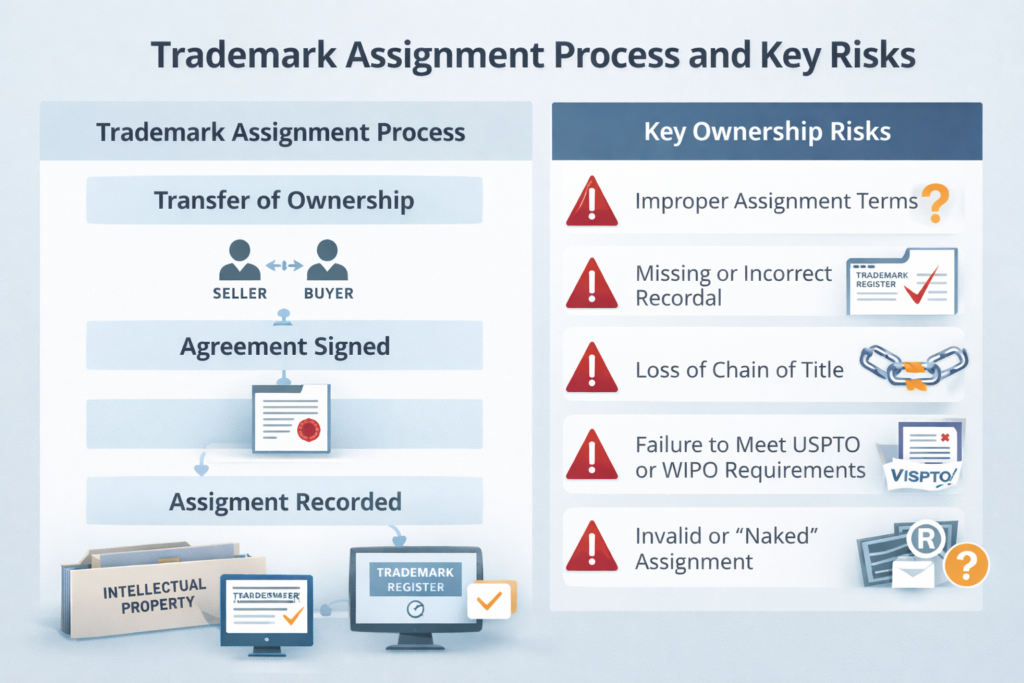
In the United States, the law provides that an assignment can be void against a later purchaser for value without notice unless it is recorded with the USPTO within three months after the date of the assignment or before that later purchase. The USPTO also explains that Assignment Center is the platform used to submit ownership transfer requests, and recorded information later updates the trademark ownership record.
That legal point is more important than it may look. Businesses sometimes sign the agreement and assume the job is done. But if the assignment is not properly recorded, the public chain of title may remain incomplete. In a dispute, financing round, audit, acquisition, or enforcement action, that gap can become a serious problem.
Can a pending trademark application be assigned?
Sometimes yes, but not always.
This is one of the most important traps in U.S. practice. If the application was filed on an intent-to-use basis under Section 1(b), it generally cannot be assigned before an Amendment to Allege Use or Statement of Use is filed, unless the assignment is to a true successor to the applicant’s business, or the relevant part of that business, and that business is ongoing and existing. Both the Lanham Act and the USPTO’s guidance make this restriction explicit.
Why does this matter? Because startups and early-stage businesses often restructure before the mark reaches registration. If they transfer a pending intent-to-use application the wrong way, they may damage the application instead of cleaning up ownership. This is one of the clearest examples of why “we’ll just update the owner later” can backfire.
What about international trademarks?
International trademark assignments are rarely as simple as transferring one U.S. registration.
If the mark is protected through the Madrid System, ownership changes involving international registrations are handled through WIPO, not directly through the USPTO for the international registration itself. WIPO provides online mechanisms to record total or partial changes in ownership, and it distinguishes true ownership changes from simple holder-detail changes.
That distinction matters because businesses with international portfolios often assume one filing solves everything. It usually does not. A brand may have:
- a U.S. national application or registration,
- one or more Madrid designations,
- separate local registrations in other countries,
- different historical owners across jurisdictions.
In that situation, the assignment project is really about chain-of-title management. The legal and administrative challenge is making sure the ownership story is consistent everywhere that matters.
How much does a U.S. trademark assignment filing cost?
At the USPTO level, there are official fees for recording ownership documents. The current USPTO fee schedule lists fee code 8521 at $40 for the first mark per document and fee code 8522 at $25 for each second and subsequent mark in the same document. That is only the government filing side; legal costs, drafting, review, chain-of-title analysis, and international recordals are separate.
This is another place where clients underestimate the work. The official fee may look small, but the real cost driver is often not the filing itself. It is fixing the ownership structure correctly, especially where the facts are messy.
Common mistakes businesses make
The legal concept is straightforward. The execution is where trouble starts.
Assuming the trademark “automatically moved”
It often does not. A business sale, founder exit, or restructuring may affect beneficial ownership economically, but trademark records still need to reflect the legal transfer properly.
Confusing assignment with a name change
If the wrong type of update is filed, the register may not show the true chain of title.
Ignoring goodwill
In U.S. practice, trademarks are not supposed to be transferred as bare words with no business connection behind them.
Assigning a Section 1(b) application too early
This is a classic avoidable error and one with real legal consequences.
Forgetting foreign filings
A company may update one key market and forget the rest of its portfolio, leaving ownership fragmented across jurisdictions.
Using a generic template without checking local rules
This is especially risky for international portfolios, where notarization, legalization, language, form, timing, and representative requirements may differ.
Waiting until due diligence to fix everything
At that point, the issue becomes more urgent, more expensive, and more visible to the other side of the deal.
When should you handle it yourself, and when should you get help?
If this is a simple domestic transfer with a clean fact pattern, some businesses can manage the filing side themselves. The USPTO provides an Assignment Center for ownership transfer requests and maintains searchable assignment records.
But professional help is usually worth it when:
- the mark is part of an acquisition or investment round;
- the portfolio includes multiple countries;
- the ownership history is unclear;
- the original applicant and actual business are different;
- the application is still pending on an intent-to-use basis;
- there is a risk that the wrong document has already been signed or filed.
In those cases, the real value is not just submitting a form. It is making sure the transfer is legally valid, commercially accurate, and usable in the future.
Final takeaway
A trademark assignment is the legal transfer of trademark ownership from one party to another. On paper, that sounds simple. In practice, it can affect chain of title, enforceability, due diligence, investor confidence, and even the validity of a pending application if handled incorrectly. U.S. law requires a written instrument, generally requires transfer with the associated goodwill, and restricts assignment of intent-to-use applications before use is properly established, except in limited successor situations. Recordal also matters because an unrecorded assignment can create avoidable ownership risk.
If your business is restructuring, selling a brand, cleaning up founder-owned IP, or preparing for investment, it is worth reviewing the assignment carefully before filing. The goal is not just to “update the register.” The goal is to make sure the brand is truly owned by the right party in a way that stands up legally and commercially.
Contact Bonamark if you need help reviewing a trademark transfer, preparing the assignment documents, or recording ownership changes in the U.S. or internationally.
FAQ
What is a trademark assignment?
A trademark assignment is the legal transfer of ownership of a trademark from one party to another.
Does a trademark assignment transfer the whole brand?
It transfers ownership of the trademark rights and, in U.S. practice, generally must include the goodwill associated with the mark.
Can a pending trademark application be assigned?
Sometimes. But U.S. intent-to-use applications have special restrictions and usually cannot be assigned before use is properly established, except to a true successor to the business.
Do I need to record the assignment?
In practice, yes. Recordal helps establish a clear public ownership record and reduces legal and commercial risk.
Can international trademarks be assigned too?
Yes, but cross-border transfers usually involve country-specific requirements, and Madrid System ownership changes are handled through WIPO.
- Trademark Assignment
Trademark services in the United States


