

















Amazon Brand Registry helps trademark owners protect their brands, control product listings, report counterfeit activity, and access additional brand-building tools inside Amazon. For most sellers, enrollment depends on eligible trademark rights, accurate brand information, and a verified Amazon seller or vendor account.
Selling on Amazon has become increasingly competitive, especially for businesses building long-term brands rather than simply listing products. Counterfeit sellers, unauthorized resellers, listing hijacking, and copycat products are common challenges for growing e-commerce companies.
Amazon Brand Registry is designed to help businesses protect their intellectual property, gain additional control over product listings, and access advanced brand tools inside Amazon Seller Central.
For most businesses, enrollment requires eligible trademark rights and a verified Amazon seller or vendor account. However, the exact requirements, timelines, and costs depend on the country, trademark status, filing route, and Amazon marketplace.
This guide explains how Amazon Brand Registry works, what requirements apply, how much registration may cost, and how businesses can avoid common application problems.
Quick Summary
Amazon Brand Registry is a program that helps sellers protect trademarks, remove counterfeit listings, and gain enhanced control over Amazon product pages. To enroll, businesses usually need eligible trademark rights, accurate brand information, and an Amazon seller or vendor account.
What Is Amazon Brand Registry?
Amazon Brand Registry is a brand protection program that gives trademark owners additional control over their products and listings on Amazon marketplaces.
Once enrolled, sellers can access tools designed to protect product listings, report counterfeit listings, remove unauthorized sellers, create enhanced brand content, improve advertising visibility, and monitor intellectual property misuse.
The program is primarily intended for businesses with eligible trademarks that actively sell products through Amazon Seller Central or Amazon Vendor Central.
Amazon Brand Registry is not a trademark registration service. Amazon uses trademark ownership to verify that an applicant has legitimate rights to the brand.
Who Can Apply for Amazon Brand Registry?
Businesses can apply for Amazon Brand Registry when they can show that they own or control an eligible brand and meet Amazon’s enrollment requirements.
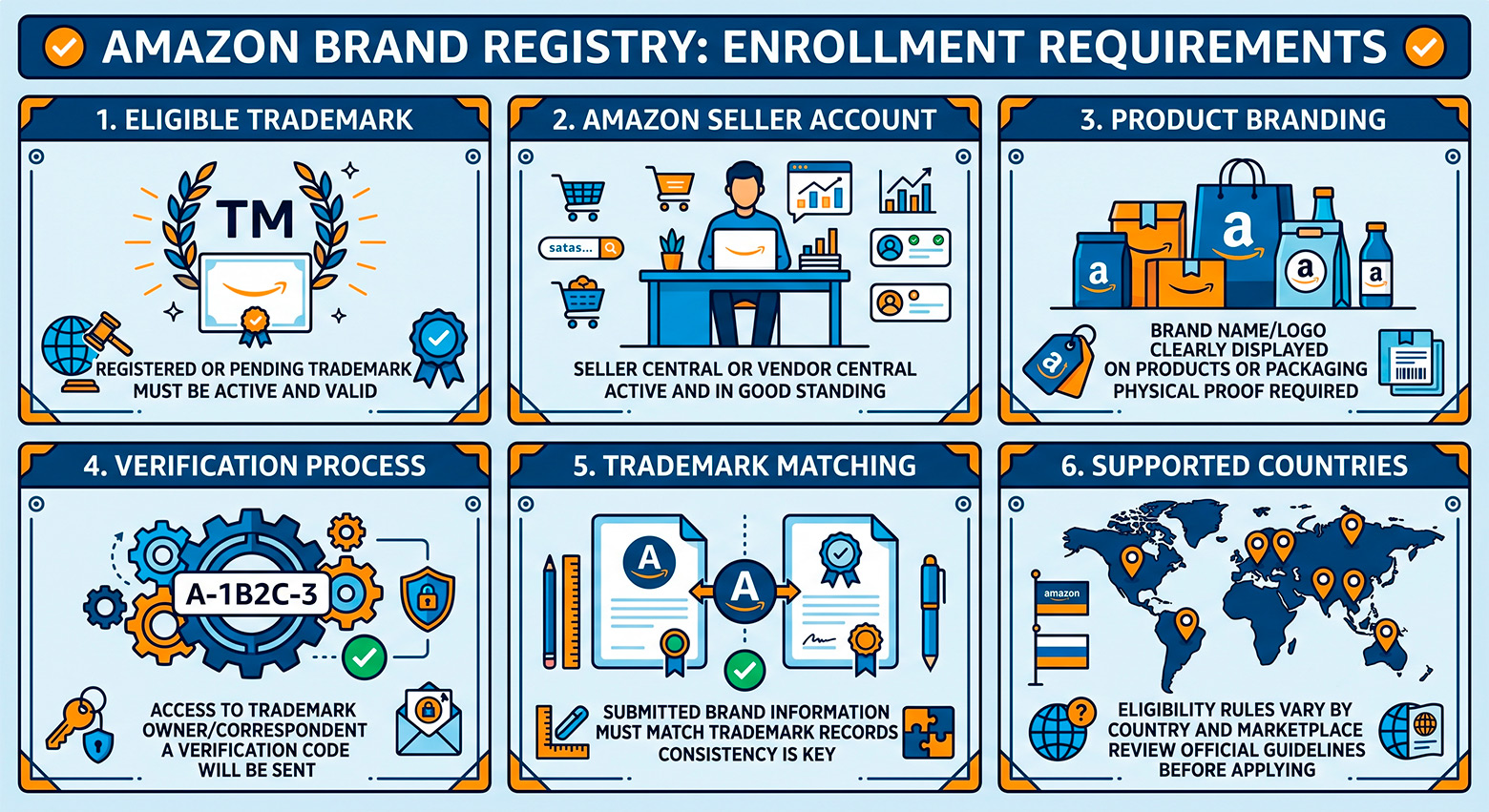
In practical terms, most applicants need:
- eligible trademark rights;
- an Amazon Seller Central or Vendor Central account;
- brand information that matches the trademark record;
- proof that the brand is used on products or packaging;
- and access to the trademark owner or correspondent for verification.
Amazon’s exact eligibility rules may vary by country, marketplace, account type, and enrollment pathway. Sellers should review the official Amazon Brand Registry eligibility requirements before applying.
Trademark Requirements for Amazon Brand Registry
One of the most important requirements for Amazon Brand Registry is an eligible trademark that Amazon can verify through a recognized trademark office or approved enrollment pathway.
Amazon may accept different types of trademarks depending on the country and marketplace, including:
- word marks;
- design marks;
- logo trademarks;
- and combined marks.
The trademark should be active, searchable in the relevant trademark database, and associated with the applicant. For U.S. sellers, a USPTO trademark registration is commonly used to support Amazon Brand Registry enrollment.
Before filing, sellers should consider a trademark clearance search to reduce the risk of choosing a brand name that conflicts with earlier marks or creates a likelihood of confusion problem later.
The brand name submitted to Amazon should match the trademark record as closely as possible. Differences in spelling, punctuation, ownership details, or logo presentation may delay verification.
Do You Need a Registered Trademark for Amazon Brand Registry?
In many cases, Amazon Brand Registry requires a registered trademark before a brand can fully enroll. However, certain sellers may gain earlier access through Amazon’s approved enrollment pathways, such as Amazon IP Accelerator.
Amazon IP Accelerator connects sellers with participating trademark service providers and may allow eligible brands to access Brand Registry while a trademark application is still pending.
This distinction matters for new e-commerce brands that do not want to wait many months for full trademark registration approval before protecting their listings on Amazon.
| Trademark status | Brand Registry eligibility |
|---|---|
| Fully registered trademark | Generally eligible if Amazon’s other requirements are met. |
| Pending trademark through Amazon’s approved enrollment pathways | May be eligible through the applicable Amazon process. |
| Trademark application filed independently | Typically insufficient on its own for immediate enrollment. |
| No trademark filed | Not eligible for enrollment. |
Many sellers assume that filing a trademark application automatically creates Brand Registry eligibility. In practice, Amazon applies additional requirements depending on the filing route, trademark status, and marketplace.
Seller Account Requirements
Most applicants need an active Amazon Seller Central or Vendor Central account connected to the brand they want to enroll.
During enrollment, Amazon may review seller identity, account details, product listings, ownership information, and marketplace activity. Businesses should ensure that their account information is accurate and consistent with the trademark ownership details whenever possible.
Brand Verification Requirements
Amazon often checks whether the trademark appears on product packaging, labels, product photos, or the products themselves. This helps Amazon confirm that the brand is genuinely used in commerce.
Businesses commonly prepare:
- product packaging images;
- logo photos;
- branded labels;
- product images;
- and listing screenshots.
The brand presentation should closely match the trademark record. If the trademark, product packaging, and Amazon application use different names or visuals, Amazon may request additional verification or reject the application.
Supported Trademark Offices
Amazon Brand Registry supports trademarks from multiple national and regional trademark offices.
Commonly accepted trademark authorities include:
- USPTO in the United States;
- EUIPO in the European Union;
- UKIPO in the United Kingdom;
- CIPO in Canada;
- and other recognized trademark offices.
Eligibility can vary depending on the marketplace and trademark jurisdiction, so sellers should confirm that their trademark office is supported before starting the application.
Amazon Brand Registry Registration Process
The Amazon Brand Registry registration process is relatively straightforward when trademark ownership, seller account details, and brand materials are prepared correctly.
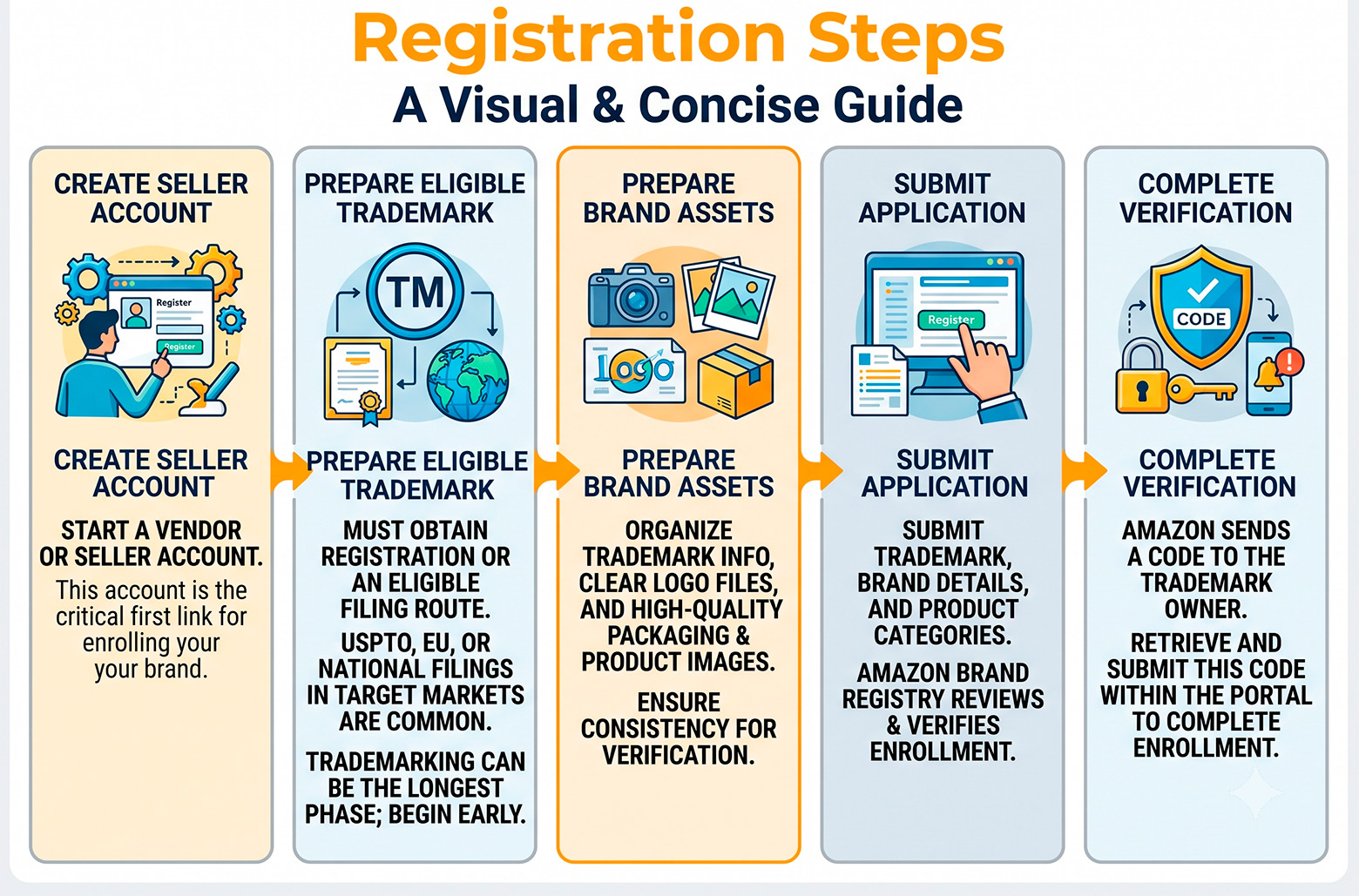
Step 1: Create or Verify Your Amazon Seller Account
Businesses first need an active Amazon seller or vendor account. This account will later be connected to the brand enrolled in Brand Registry.
Step 2: Register or Prepare an Eligible Trademark
Most sellers need to register a trademark or use an eligible trademark filing route. Many businesses file a USPTO trademark, an EU trademark, or a national trademark in their target market.
Trademark registration is often the longest step in the process, so sellers planning to launch on Amazon should consider trademark registration early.
Step 3: Prepare Brand Materials
Before applying, businesses should prepare trademark registration information, product photos, packaging images, logo files, and marketplace details. Consistency matters during verification.
Step 4: Submit the Amazon Brand Registry Application
Applicants submit trademark information, country details, brand details, and product categories through Amazon Brand Registry. Amazon then begins the enrollment review and verification process.
Step 5: Complete Verification
Amazon may send a verification code to the trademark owner or correspondent listed in the trademark database. The applicant must retrieve and submit that code inside the Brand Registry portal to complete enrollment.
How Long Does Amazon Brand Registry Take?
Amazon Brand Registry review can take only a few days after the trademark is eligible, but the full timeline may be much longer if the seller still needs to obtain a trademark registration.
| Process | Estimated timeline |
|---|---|
| Brand Registry enrollment review | Several days to 2 weeks in many cases. |
| USPTO trademark registration | Commonly 8–12 months, although processing times vary. |
| IP Accelerator access | Often faster than waiting for full trademark registration. |
| Amazon verification code process | Usually a few days when the correct contact receives the code. |
The timeline depends on trademark status, seller account details, verification responsiveness, and Amazon’s review process.
Amazon Brand Registry Costs
Amazon itself does not usually charge a separate Brand Registry enrollment fee. However, businesses commonly incur trademark-related costs before they can qualify.
| Service | Typical cost |
|---|---|
| USPTO trademark filing fee | $350–$550 per class |
| Trademark attorney assistance | Varies by provider and filing complexity. |
| Amazon IP Accelerator legal fees | Usually higher than a basic direct filing. |
| Trademark monitoring services | Optional recurring cost. |
Actual costs vary depending on the number of trademark classes, jurisdiction, filing strategy, and whether professional assistance is used. Businesses should also consider trademark search costs, international filing costs, and long-term trademark renewal expenses.
Benefits of Amazon Brand Registry
Amazon Brand Registry gives trademark owners stronger tools for protecting listings, managing product content, and building brand visibility across Amazon marketplaces.
| Feature | Benefit |
|---|---|
| Brand Protection Tools | Report counterfeit listings and intellectual property infringement. |
| A+ Content | Improve product presentation and conversion potential. |
| Sponsored Brands Ads | Access advanced advertising formats. |
| Amazon Stores | Build a branded storefront inside Amazon. |
| Automated Protections | Help Amazon proactively detect possible misuse. |
| Brand Analytics | Access customer and search insights. |
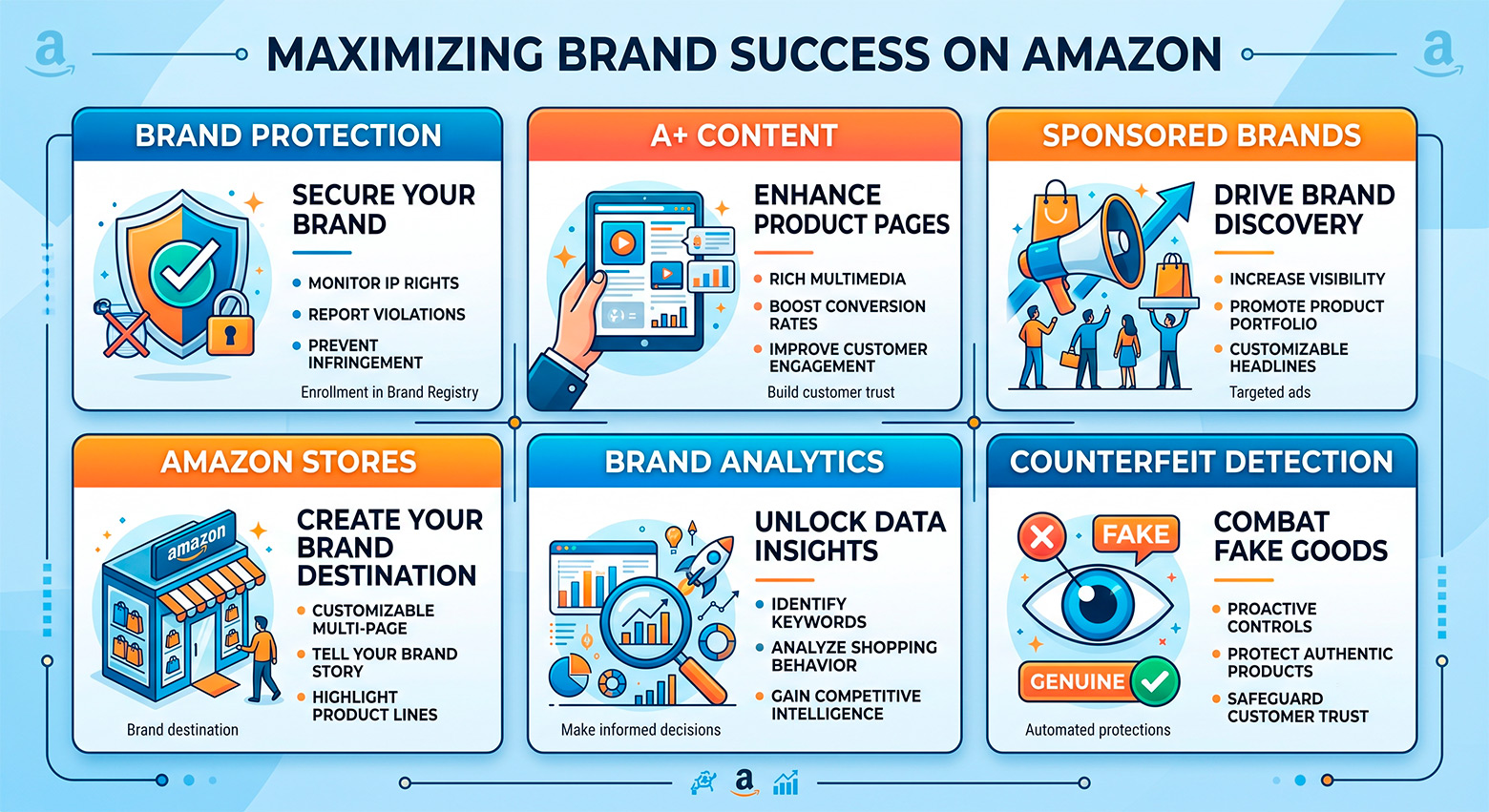
The exact tools available may vary by marketplace, account type, and Amazon program participation. For many e-commerce companies, Brand Registry becomes an essential part of long-term marketplace growth.
Amazon Brand Registry vs Selling Without Brand Registry
Amazon sellers can list products without Brand Registry, but they usually have fewer tools for brand control, counterfeit reporting, and enhanced product content.
| Feature | With Brand Registry | Without Brand Registry |
|---|---|---|
| Listing control | Stronger control over brand-related listing content. | More limited control. |
| Counterfeit reporting | Access to dedicated reporting tools. | More limited reporting options. |
| A+ Content | Available for eligible brands. | Usually unavailable. |
| Sponsored Brands | Available for eligible sellers. | Generally unavailable. |
| Brand Analytics | Available depending on account and marketplace. | Usually unavailable. |
For sellers building a long-term private label or product brand, Brand Registry often creates a stronger operational foundation than selling without trademark-based protection.
Amazon Brand Registry vs Amazon IP Accelerator
Amazon Brand Registry and Amazon IP Accelerator are connected, but they are not the same service.
| Amazon Brand Registry | Amazon IP Accelerator |
|---|---|
| Brand protection program | Trademark filing network |
| Requires trademark ownership or eligible trademark status | Helps sellers obtain trademarks through participating providers |
| Managed by Amazon | Works with external law firms or service providers |
| Protects listings and products | May speed access to Brand Registry |
Amazon IP Accelerator is often used by sellers who want faster marketplace protection while their trademark application is still pending.
Can Amazon Brand Registry Protect You from Listing Hijacking?
Amazon Brand Registry can help reduce listing hijacking risks, but it does not guarantee that unauthorized sellers or bad actors will never appear on a listing.
Brand Registry gives sellers stronger tools to report counterfeit listings, challenge unauthorized changes, and protect brand-related product content. It may also help Amazon identify and remove certain types of misuse more efficiently.
However, sellers should still monitor listings, track unauthorized sellers, document infringement, and maintain accurate trademark records. Brand Registry is a powerful protection layer, not a replacement for ongoing brand enforcement.
Common Reasons Amazon Brand Registry Applications Get Rejected
Many Amazon Brand Registry applications fail because of preventable inconsistencies between the trademark record, seller account, product branding, and submitted application details.
- Trademark owner mismatch
- Incorrect trademark registration numbers
- Logo or brand name differences
- Packaging inconsistencies
- Unsupported trademark types
- Inactive trademark registrations
- Missing product branding
- Verification code failures
Businesses should carefully review all submitted information before applying. A small inconsistency can delay approval or require a new application.
How Amazon Brand Registry Helps Protect Brands
Amazon Brand Registry helps sellers protect their brands by giving them tools to detect, report, and reduce intellectual property misuse across Amazon listings.
Unauthorized sellers and counterfeit listings remain major concerns across Amazon marketplaces. Brand Registry gives businesses access to infringement reporting tools, automated counterfeit detection, search reporting systems, and enhanced listing control.
This can help businesses reduce listing hijacking, protect customer trust, and maintain consistent brand presentation. For growing e-commerce companies, trademark registration and Brand Registry often work together as part of a broader brand protection strategy.
Is Amazon Brand Registry Worth It?
For most serious Amazon sellers, Amazon Brand Registry is worth considering because it combines trademark-based protection with practical e-commerce growth tools.
Businesses with private label products, original branding, long-term e-commerce plans, or recurring counterfeit issues usually benefit significantly from Brand Registry enrollment.
The combination of trademark protection, listing control, advertising access, and anti-counterfeit tools can provide both operational and commercial advantages.
Need Help Preparing a Trademark for Amazon Brand Registry?
Planning to enroll in Amazon Brand Registry? Bonamark can help you perform a trademark search, develop a filing strategy, and prepare a trademark application that supports your long-term brand protection goals.
After enrollment, ongoing trademark monitoring can also help sellers identify potentially conflicting marks, marketplace misuse, and brand protection risks outside the Brand Registry workflow.
Contact Bonamark to ensure your trademark is filed correctly. Our consultants can guide you through trademark search, filing strategy, and brand protection steps before you apply for Amazon Brand Registry.
Final Thoughts
Amazon Brand Registry has become an important protection and growth tool for modern e-commerce brands.
For many businesses, enrollment is closely connected to trademark registration strategy, marketplace expansion, and long-term brand protection.
Companies planning to sell products on Amazon should prepare a properly structured trademark application, consistent brand materials, and accurate seller account information before starting the registration process.
A strong trademark foundation can help businesses access Brand Registry more smoothly while reducing the risk of delays or verification issues.
FAQ
Do I need a registered trademark for Amazon Brand Registry?
In most cases, Amazon Brand Registry requires eligible trademark rights. A registered trademark is commonly used, while certain pending applications may qualify through Amazon's approved enrollment pathways.
Can I use a pending trademark application?
A standard pending trademark application is usually not enough by itself. However, trademarks filed through Amazon IP Accelerator or another approved enrollment pathway may qualify for earlier Brand Registry access.
How much does Amazon Brand Registry cost?
Amazon usually does not charge a direct Brand Registry fee, but businesses typically pay trademark filing costs, legal fees, and optional monitoring expenses.
How long does Amazon Brand Registry approval take?
Once the trademark is eligible, Brand Registry enrollment review may take anywhere from several days to a couple of weeks, depending on the marketplace and verification process.
Can I enroll without an Amazon seller account?
Most businesses need an Amazon Seller Central or Vendor Central account connected to the brand before enrollment.
Does Amazon Brand Registry help prevent counterfeit listings?
Brand Registry helps businesses detect and report counterfeit listings more efficiently, but ongoing monitoring and enforcement are still important.