


















The USPTO base trademark application fee is $350 per class, but most applicants ultimately pay more. The total cost depends on the number of classes, whether the application includes custom or incomplete information, and whether the filing is based on use in commerce or intent to use.
USPTO filing fee — key facts
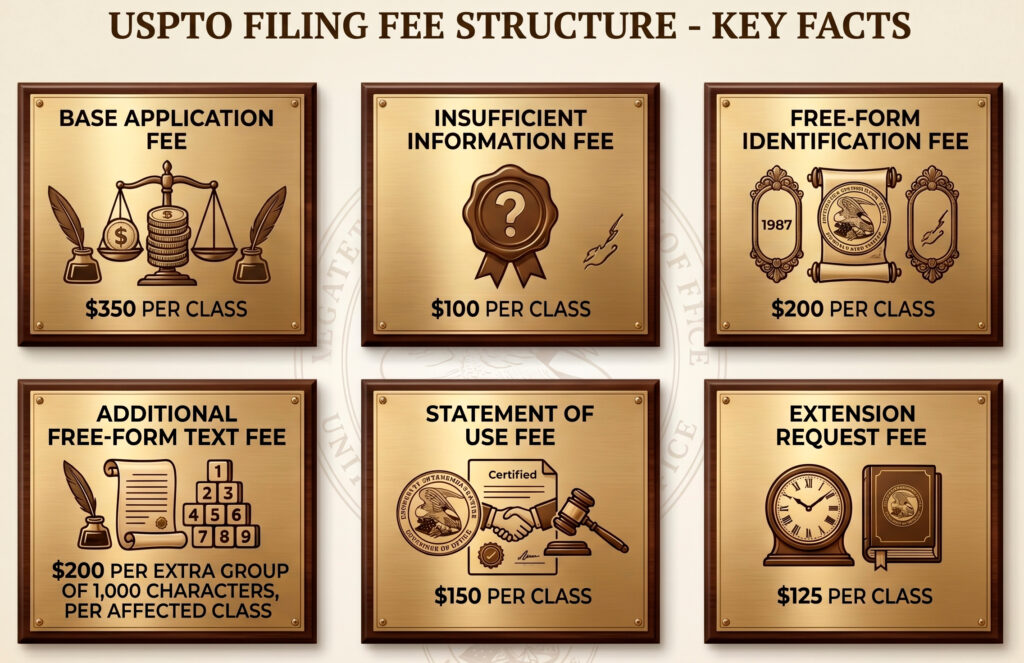
- Base application fee: $350 per class
- Insufficient information fee: $100 per class
- Free-form identification fee: $200 per class
- Additional free-form text fee: $200 per extra group of 1,000 characters, per affected class
- Statement of Use fee: $150 per class
- Extension request fee: $125 per class
What does “per class” mean in a trademark application?
USPTO trademark fees are charged per class of goods or services. One application can cover multiple classes, but each class increases the filing cost.
For example, a business selling clothing and also providing retail or software services may need more than one class. That means the fee is multiplied, not bundled into one flat price.
What is the base USPTO trademark filing fee?
The base filing fee is $350 per class for most electronically filed Section 1 and Section 44 applications, as long as the application meets the base filing requirements.
USPTO trademark filing fees in 2026 start at $350 per class. Additional costs may apply for intent-to-use filings, Statements of Use, extension requests, custom descriptions, and insufficient application information.
This is the minimum filing fee, not the guaranteed total cost of trademark registration.
Why do trademark filing costs often end up higher than expected?
Most unexpected costs come from three issues: extra classes, application complexity, and later required filings.
| Cost driver | What happens | Why it matters |
|---|---|---|
| Multiple classes | The base fee is charged for each class | Costs increase quickly for broader filings |
| Incomplete application | An additional fee may apply | Applicants pay more and often face delays |
| Free-form identification | Extra review fees may apply | Custom wording is more expensive and riskier |
| Intent-to-use basis | Later filings are required | The initial fee is only part of the full cost |
What additional USPTO fees should applicants know about?
The USPTO now uses additional fees to encourage complete and standardized filings. These fees are especially relevant for applicants who do not use the Trademark ID Manual or who submit incomplete information.
| Fee | Amount | When it applies |
|---|---|---|
| Insufficient information fee | $100 per class | When the required application information is missing |
| Free-form text identification fee | $200 per class | When the applicant uses free-form wording instead of the Trademark ID Manual |
| Extra free-form text fee | $200 per extra 1,000 characters, per affected class | When the custom identification is unusually long |
Why are custom identifications more expensive?
Custom or free-form identifications require more review. They also increase the chance that the examining attorney will need clarification or will object to the wording.
In practice, applicants often assume that custom wording is more precise. But for most filings, using the USPTO ID Manual is the safer and cheaper option.
Intent-to-use vs. use-based filing — how do the costs differ?
Use-based and intent-to-use applications start with the same base filing fee, but intent-to-use filings usually cost more over time because they require additional documents and fees before the mark can register.
| Filing basis | Initial fee | Later fees | Cost profile |
|---|---|---|---|
| Use-based | $350 per class | Usually fewer filing-stage add-ons | More predictable |
| Intent-to-use | $350 per class | $150 per class for a Statement of Use and $125 per class for each extension request | Higher lifecycle cost |
What later fees apply to intent-to-use applications?
If you file under an intent-to-use basis, the application cannot register until you show actual use in commerce.
That usually means paying:
- $150 per class when filing an Amendment to Allege Use or a Statement of Use
- $125 per class for each request for an extension of time to file a Statement of Use
This is one of the main reasons early-stage founders underestimate the true cost of filing.
What happens if your application is incomplete?
An incomplete application can trigger the insufficient information fee and may also slow down the examination. In some cases, filing mistakes create a chain reaction: extra fees, examiner questions, and a longer path to registration.
If the problem is serious and not corrected, the application may be refused or abandoned, which means the time and money already spent may not lead to registration.
Real-world scenario: how trademark costs increase in practice
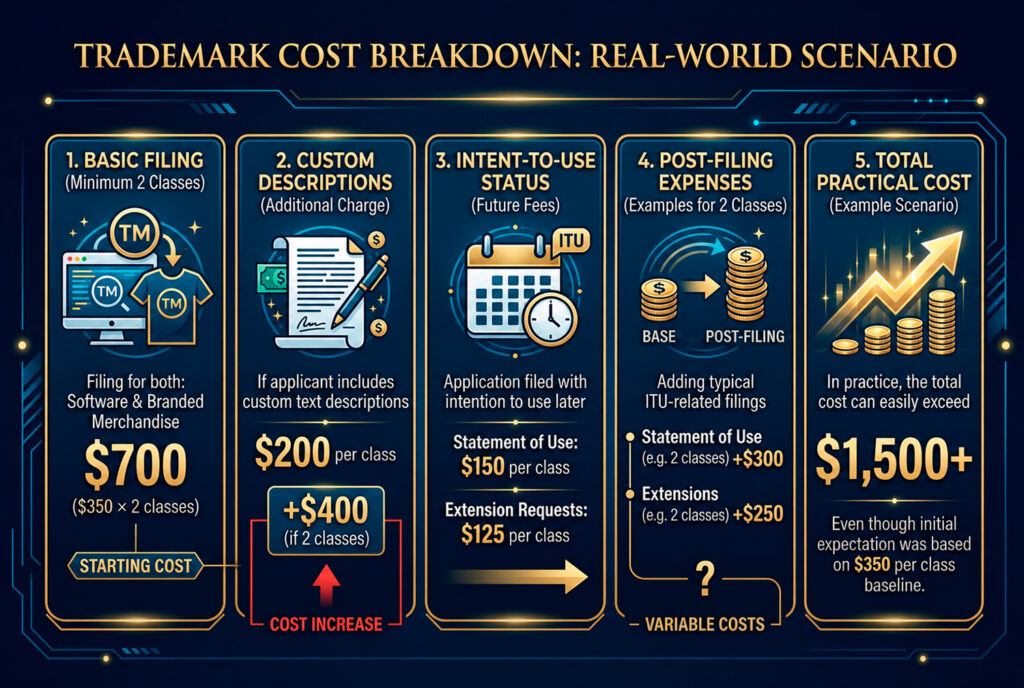
Consider a startup that files a trademark for both software and branded merchandise. This typically requires at least two classes.
The base filing cost starts at $700 ($350 × 2 classes). However, if the application includes custom descriptions, the applicant may pay an additional $200 per class, increasing the total to $1,100.
If the application is filed on an intent-to-use basis, the applicant may later need to pay:
- $150 per class for a Statement of Use
- $125 per class for extension requests
In practice, the total cost can easily exceed $1,500, even though the initial expectation was based on the $350 per class baseline.
Real-world scenario: how applicants accidentally overpay
A common example is a founder filing before launch and trying to describe goods or services in highly customized language. The application may look more “specific,” but it can trigger the $200 free-form text fee, additional character-based fees, and requests for clarification.
If the same filing is also based on intent to use, the applicant may later need to pay for a Statement of Use and one or more extensions. The result is a much higher total cost than the original $350 per class suggested.
How can you reduce trademark filing costs without cutting corners?
Checklist before filing:
- Use pre-approved descriptions from the USPTO Trademark ID Manual whenever possible
- Confirm the correct number of classes before filing
- Make sure all required information is complete and consistent
- Avoid unnecessary free-form wording
- Choose the right filing basis based on whether the mark is already in use
- Budget for later filings if you choose an intent-to-use basis
Can a trademark filing cost more than expected?
Yes. That happens often, especially when applicants treat the $350 fee as the full registration cost. The actual cost rises when the filing includes multiple classes, custom wording, missing information, or later required filings.
What happens after registration?
Registration is not the end of trademark costs. The USPTO also requires maintenance filings after registration, including declarations of use and renewals at specific intervals. Applicants planning long-term brand protection should view filing fees as part of a longer lifecycle, not a one-time expense.
How long does the USPTO trademark process take?
The timeline for trademark registration depends on the application quality and whether additional actions are required.
- Initial examination: typically 6–8 months after filing
- Publication period: 30 days for opposition
- Registration (use-based): several months after approval
- Intent-to-use applications: longer due to Statement of Use and possible extensions
Incomplete or complex applications often take longer, which can increase both costs and business risk.
Conclusion
The USPTO filing fee starts at $350 per class, but the real cost of registration is usually higher. Businesses that understand the fee structure early are better positioned to file efficiently, avoid preventable charges, and move through the process with fewer delays.
Contact Bonamark to ensure your trademark is filed correctly. Our consultants can guide you.
FAQ
How much does it cost to file a trademark with the USPTO?
The base fee is $350 per class, but the total cost may be higher if additional fees apply or if the application is filed on an intent-to-use basis.
Do you pay the USPTO fee once or per class?
You pay the filing fee per class of goods or services, not once per application.
Why do some trademark applications cost more than $350?
Applications often cost more because of extra classes, missing information, free-form identifications, or later filings required for intent-to-use applications.
What is the fee for insufficient information?
The insufficient information fee is $100 per class.
What is the fee for using free-form text instead of the ID Manual?
The USPTO charges $200 per class when an applicant uses the free-form text box instead of the Trademark ID Manual to identify goods or services.
How much does a Statement of Use cost?
A Statement of Use costs $150 per class.
How much does an extension request cost for an intent-to-use application?
An extension request costs $125 per class.
Can you reduce trademark filing costs?
Yes. The best way to reduce costs is to file a complete application, use standardized identifications where possible, choose the correct classes, and budget for follow-up filings if the mark is not yet in use.
- Trademark registration
- USPTO
- Trademark Fees
Trademark services in the United States


