













If your business operates in Michigan and you want to protect a brand name, logo, or slogan within the state, a Michigan state trademark can be a fast and relatively inexpensive way to secure your rights locally. It does not replace a federal USPTO registration, but it strengthens your position in Michigan and helps you stop confusingly similar uses.
This guide explains how to register a trademark or service mark with the Michigan Department of Licensing and Regulatory Affairs (LARA) – Corporations Division and when it makes sense to seek federal protection instead.
Key Facts
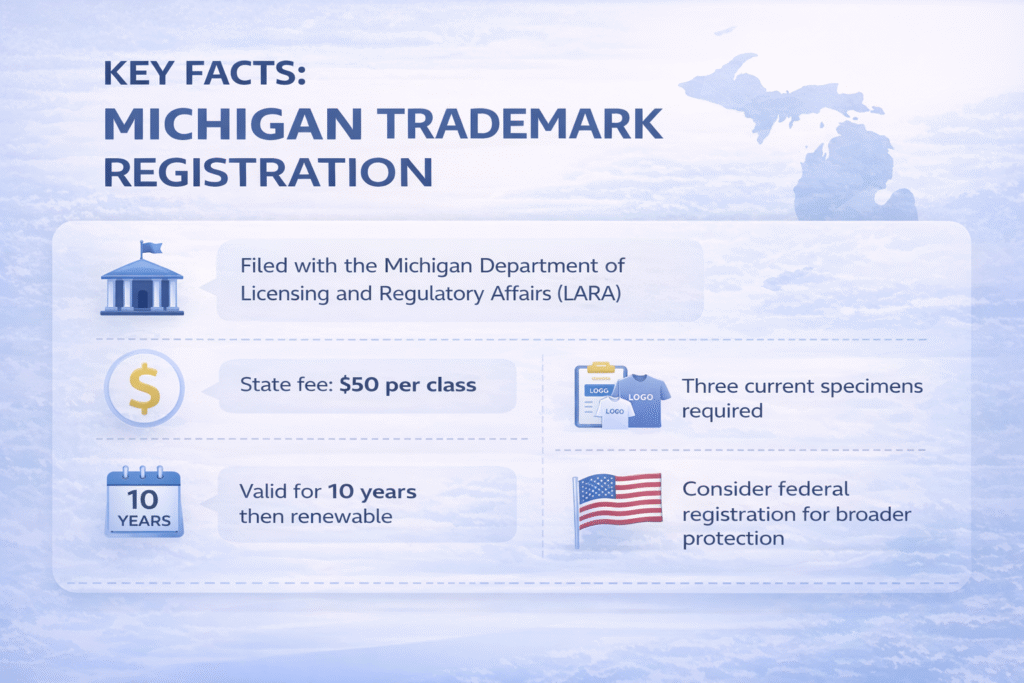
- Authority: Michigan Department of Licensing and Regulatory Affairs (LARA), Corporations Division – Trademark, Service Mark & Insignia.
- Application form: Application for Registration of Trademark/Service Mark (Form CSCL/CD-600).
- Filing method: By mail or in person; some filings can be initiated through the MiBusiness Registry portal.
- Filing fee: USD $50 per application (non‑refundable).
- Specimens: Two specimens (samples) of the mark as actually used in Michigan commerce.
- Use requirement: The mark must already be in use in Michigan before you file.
- Term: 10 years from registration, renewable for additional 10‑year terms.
- Scope: Protection only within Michigan.
- Federal USPTO alternative: For nationwide protection, consider a federal U.S. trademark registration (application fees typically around $350–$550 per class, depending on the filing option and details).
If your business already serves customers in multiple states or primarily sells online, consider a federal U.S. trademark registration instead of, or in addition to, a Michigan state registration.
What is a Michigan state trademark?
A Michigan state trademark (or service mark) is a word, phrase, logo, or other symbol registered with LARA for use on specific goods or services in Michigan. Registration:
- creates a public record that you claim rights in the mark for certain goods/services,
- helps prevent others in Michigan from using confusingly similar marks,
- strengthens your position in cease‑and‑desist letters and enforcement actions under Michigan law.
However, a Michigan registration does not automatically protect you in other states. For broader protection, you would normally file a federal trademark application with the USPTO.
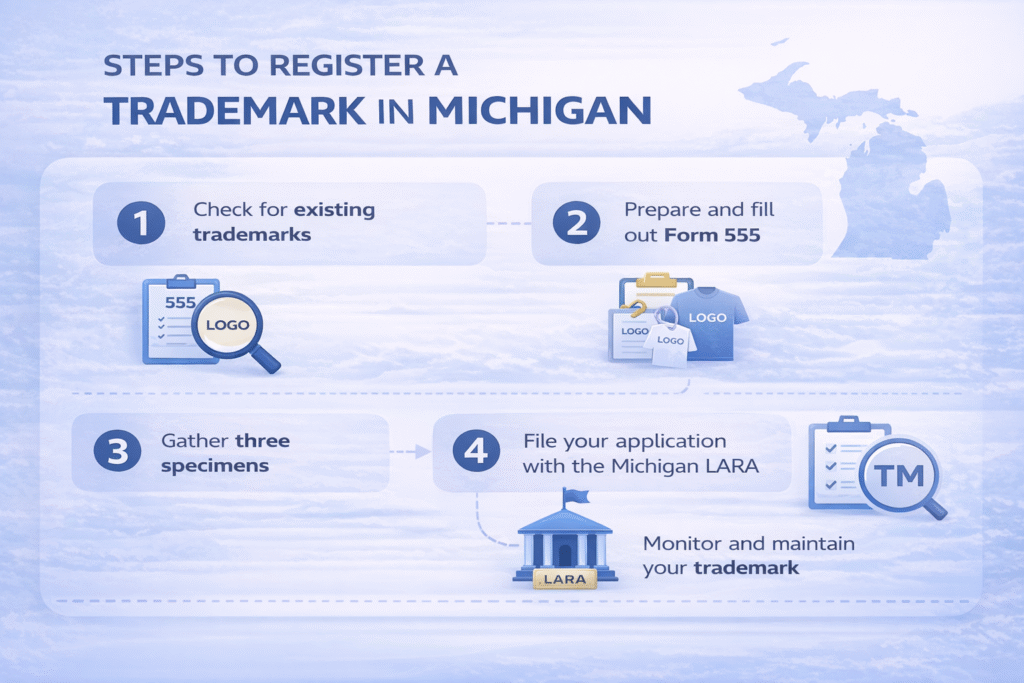
Step 1: Search existing trademarks in Michigan
Before you invest in registration, you should check that your mark is available and not already in use for similar goods or services.
- Search the Michigan trademark and service mark records
LARA maintains records of registered trademarks, service marks, and insignia. Use the available search tools (or contact the Corporations Division) to look for:- exact matches,
- similar spellings and phonetic equivalents,
- plural/singular versions, abbreviations, and acronyms,
- similar‑looking logos or stylized marks.
- Search beyond the Michigan registry
Even if the state records look clear, you should still check:- USPTO TESS for federal trademark registrations and pending applications,
- domain names and social media usernames for similar brands,
- search engines (Google, Bing) for business names, product names, and marketing uses.
- Evaluate the risk of conflicts
If you find marks that look or sound similar and cover related goods or services, your application could be refused, or you could face disputes later. In borderline situations, it may be safer to adjust your mark before filing.
Need deeper risk analysis? Bonamark offers professional trademark searches that combine state, federal, and common‑law sources to help you understand the risk before you apply.
Step 2: Make sure you are using the mark in Michigan
Michigan is a “use‑based” state. You cannot register a mark based only on an intent to use it in the future. Instead, you must already be using the mark in commerce in Michigan before you file.
“Use in commerce” generally means that you are actually selling goods or providing services in Michigan under the mark – not just planning or reserving a name.
- For goods: the mark should appear on products, labels, tags, or packaging that are sold or transported in Michigan.
- For services: the mark should be used in advertising, websites, brochures, or other materials that promote services actually being offered in Michigan.
Keep proof of how and when you started using the mark. This information will be needed both in the application and for future renewals.
Step 3: Prepare your Michigan trademark application
Michigan uses the Application for Registration of Trademark/Service Mark (Form CSCL/CD‑600). In the application, you will provide:
- Owner details – the individual or business entity that owns the mark, including address and contact information.
- Type of mark – indicate whether you are registering a trademark (goods) or service mark (services).
- Exact representation of the mark – the word mark, design/logo, or a combination. For design marks, you will describe the mark and may attach a depiction.
- Description of goods/services – clearly describe what you sell or which services you provide under the mark.
- Classification – identify the appropriate class(es) of goods or services. Michigan generally follows standard trademark classifications.
- First‑use dates – the date of first use anywhere and the date of first use in Michigan.
- Two specimens – samples of the mark as actually used in Michigan commerce (see below).
Specimen requirements in Michigan
Michigan law requires two specimens or facsimiles of the mark as used at the time of applying for registration. These specimens should show the mark in real‑world use, not just in a design mock‑up.
Typical examples include:
- product labels, packaging, or tags showing the mark,
- photographs of the mark on the product, container, or point‑of‑sale display,
- brochures, flyers, or printed advertisements,
- screenshots of a website where the mark is used to offer services, along with clear references to the services and a way for customers in Michigan to engage with you.
Make sure the spelling, layout, and design of the mark on the specimens match the description in your application. Significant differences can cause delays or refusal.
Step 4: File your application with LARA
Once your application and specimens are ready, you can submit them to LARA’s Corporations Division.
- Complete and review Form CSCL/CD‑600
Use the latest version of the form from LARA and double‑check that all required fields are completed correctly. - Prepare the filing fee
The standard filing fee is USD $50 per application. The fee is non‑refundable, even if the application is refused or later abandoned. - Attach two specimens
Include two acceptable specimens of the mark in use. Follow any formatting instructions provided by LARA (for example, acceptable paper size and clarity of images). - Submit the application
You can typically file by mail or deliver the documents in person to the Corporations Division. Michigan also offers an online MiBusiness Registry portal for many business filings; check whether online options are available for your situation.
After filing, the state will examine your application for completeness, compliance with Michigan law, and conflicts with existing marks. If there are issues (for example, missing information, unacceptable specimens, or conflicts), you may receive a letter requesting clarification or corrections.
If the application is approved, LARA will issue a Certificate of Registration confirming your Michigan state trademark or service mark rights.
Step 5: Use, monitor, and enforce your Michigan trademark
Registration is only one part of building a strong brand. You must continue to use and protect your mark.
Use the mark consistently
- Use the mark in the same form as it appears in your registration.
- Avoid major spelling or design changes without considering a new filing.
- Keep records and updated specimens showing ongoing use in Michigan.
Monitor the marketplace
- Watch competitors in Michigan for similar names or logos in related industries.
- Monitor online marketplaces, directories, and social media where your customers are active.
- Pay attention to local advertising, signage, and product packaging in your niche.
Enforcement options
If someone uses a confusingly similar mark in Michigan, you may be able to:
- send a cease‑and‑desist letter demanding that they stop the infringing use,
- negotiate a coexistence or rebranding agreement,
- take legal action under Michigan trademark and unfair competition laws if necessary.
A state registration makes it easier to demonstrate that you own the mark and that your rights predate the infringing use.
Step 6: Renewal and maintenance (10‑year term)
In Michigan, a state trademark registration is effective for 10 years from the registration date and can be renewed for additional 10‑year terms as long as the mark is still in use.
Renewal basics
- LARA typically sends a renewal application to the owner about six months before the registration expires.
- You must file the renewal form and pay the applicable renewal fee within the renewal window.
- You should be prepared to confirm that the mark is still in active use and provide updated contact information for the owner.
If you fail to renew on time, your registration will lapse, and you may need to start over with a new application (and risk losing priority to others).
Michigan state trademark vs federal USPTO registration
| Feature | Michigan State Trademark | Federal (USPTO) Trademark |
|---|---|---|
| Scope of protection | Within the State of Michigan only | Nationwide across all U.S. states and territories |
| Authority | Michigan LARA – Corporations Division | United States Patent and Trademark Office (USPTO) |
| Filing fee | Approx. $50 per application | Approx. $350–$550 per class (TEAS Plus / TEAS Standard), plus possible surcharges |
| Registration term | 10 years, renewable for additional 10‑year terms | 10 years, with separate maintenance filings at years 5–6 and at each renewal |
| Use requirement | Mark must be in use in Michigan before filing | “Use in commerce” required before registration; some filings can start based on intent to use |
| Best suited for | Businesses focused primarily on Michigan markets | Brands selling or planning to sell in multiple states or online nationwide |
If your brand is already crossing state lines – through e‑commerce, franchising, or regional distribution – consider combining your Michigan registration with a federal U.S. trademark registration for broader and stronger protection.
Frequently Asked Questions
Do I have to register my trademark in Michigan to have rights?
No. You gain some common‑law rights just by using a mark in Michigan commerce. However, state registration creates a clear public record of your claim, strengthens your position in disputes, and can make enforcement easier.
How many specimens do I need for a Michigan trademark application?
Michigan requires two specimens (samples) of the mark as actually used in commerce at the time of filing. These can include labels, packaging, photographs, or marketing materials that clearly show the mark.
Can I file in Michigan if I have not started using the mark yet?
No. Michigan requires actual use of the mark in commerce within the state before you apply. If you are not yet using the mark, you may consider planning for a future filing once use begins, or exploring federal options that allow “intent‑to‑use” applications.
How long does a Michigan state trademark registration last?
A Michigan state trademark registration is valid for 10 years from the date of registration. It can be renewed for successive 10‑year terms as long as the mark remains in use and you file the renewal on time.
When should I consider a federal USPTO registration instead of only a Michigan registration?
You should consider a federal registration if you sell or plan to sell in multiple states, operate an online business with a national customer base, plan to license or franchise your brand, or need stronger tools to combat infringement beyond Michigan.
- Trademark registration
- USA
- U.S. states guide
Trademark services in the United States