













Registering a trademark in Wisconsin is an effective way to protect your brand within the state. A Wisconsin state trademark registration gives you enforceable rights, public notice of ownership, and protection against confusingly similar uses inside Wisconsin. While it does not replace a federal USPTO registration, it is a cost‑effective option for businesses focused on local markets.
This guide is based on the requirements of the Wisconsin Department of Financial Institutions (DFI) — Trademark Section and follows Bonamark’s Version 2.0 enhanced editorial template.
Key Facts
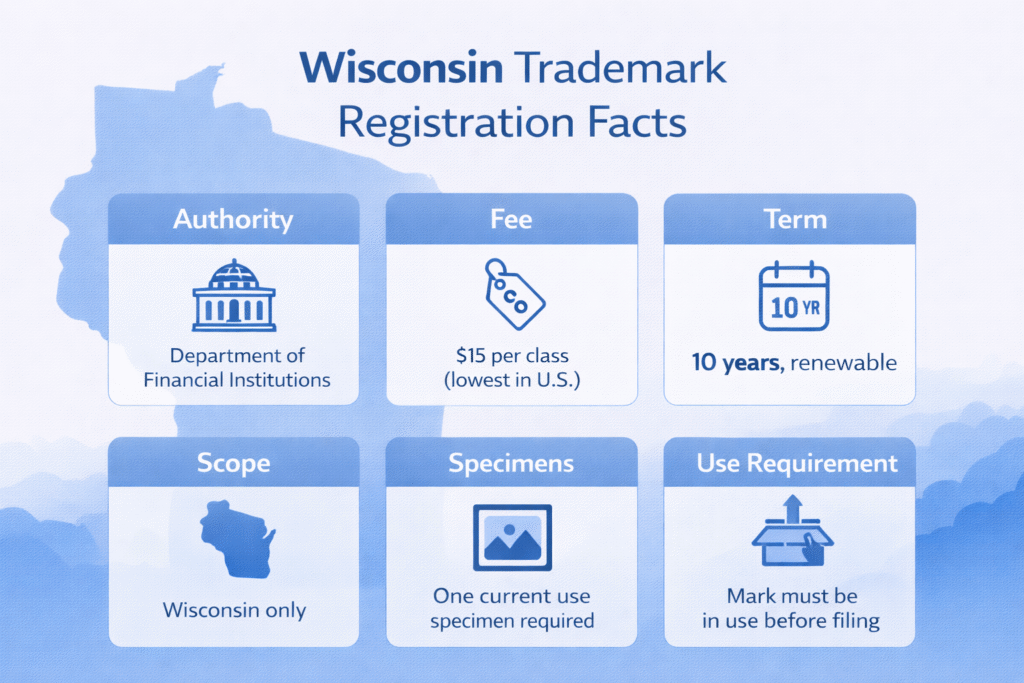
- Authority: Wisconsin Department of Financial Institutions (DFI)
- Application form: Wisconsin Trademark / Service Mark Application
- Filing method: By mail or in person
- Filing fee: $15 per class (one of the lowest in the U.S.)
- Specimens: One (1) specimen showing actual use
- Use requirement: The mark must already be in commercial use in Wisconsin
- Term: 10 years, renewable
- Scope: Protection limited to the State of Wisconsin
- Federal USPTO option: Nationwide protection; federal fees: $350–$550 per class
For nationwide rights, consider pairing state protection with a federal U.S. trademark application: U.S. trademark registration with Bonamark.
What is a Wisconsin state trademark?
A Wisconsin state trademark is a word, name, symbol, logo, or design registered with the Wisconsin DFI to identify goods or services sold in the state. Registration:
- creates a public record of your claim,
- helps prevent similar uses within Wisconsin,
- strengthens cease‑and‑desist enforcement locally.
However, it does not grant nationwide protection — for that you need federal USPTO registration.
Trademark types available in Wisconsin
- Word marks: brand names, slogans, and textual identifiers.
- Design marks: logos or stylized graphics.
- Combined marks: text + logo used together.
- Service marks: identify and distinguish services.
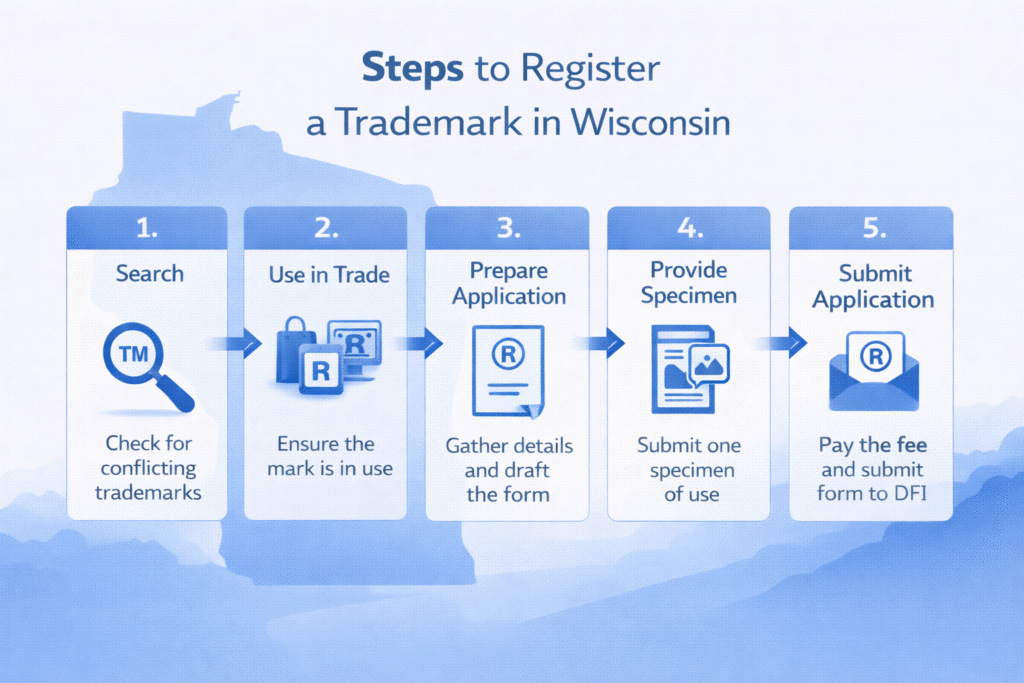
Step 1: Search for conflicting trademarks in Wisconsin
Searching before filing helps avoid refusals and disputes.
Where to search
- Wisconsin state trademark database
- USPTO TESS system
- Domain names
- Social media profiles
- General searches for common‑law use
Tip: Look for similar spellings, abbreviations, and phonetic equivalents — not just exact matches.
Step 2: Confirm that your mark is in use in Wisconsin
Wisconsin is a use‑based state. You must already be using your mark in trade before filing.
- Goods: label, packaging, tags, product photos.
- Services: ads, brochures, signs, website screenshots, digital marketing materials.
You must provide your date of first use anywhere and first use in Wisconsin.
Step 3: Prepare your Wisconsin trademark application
- Owner details: name, address, entity type
- Description of the mark: wording or design description
- Class of goods/services: international classification
- Goods/services description: specific and accurate
- First‑use dates: anywhere + in Wisconsin
- Specimen: one example showing actual use
- Declaration: confirming ownership and accuracy
Step 4: Provide acceptable specimens of use
Wisconsin requires one (1) clear specimen of current commercial use.
Acceptable specimens
- product packaging, labels, or tags,
- photographs of goods with the mark,
- advertisements, brochures, flyers, menus,
- website screenshots showing the mark with goods/services.
Avoid these specimens
- internal documents,
- unused mockups,
- business cards and letterhead (not always accepted for goods),
- materials showing a different version of the mark.
Important: The specimen must match the mark exactly as filed.
Step 5: File your application with the Wisconsin DFI
- Review the form and verify accuracy
- Attach the specimen
- Pay the $15 per class fee
- Submit via mail or in person
Wisconsin’s review process is usually faster than many states due to simple requirements and low fees.
Step 6: Examination and registration
The DFI examiner will verify:
- the accuracy of your information,
- proper specimen use,
- whether the mark is registrable.
If accepted, you’ll receive a Certificate of Registration valid for 10 years.
Step 7: Renewal (10‑year term)
- Renew every 10 years
- Confirm ongoing use
- Pay renewal fee
Failure to renew results in expiration of your state rights.
Common filing mistakes in Wisconsin
- choosing descriptive or generic names,
- submitting weak or invalid specimens,
- incorrect first‑use dates,
- vague descriptions of goods/services,
- filing before using the mark,
- using different versions of the mark across materials.
Trademarking a business name in Wisconsin
A business name registration is not the same as a trademark. To trademark a business name in Wisconsin, it must:
- function as a brand identifier,
- appear on acceptable specimens,
- be distinctive enough for state registration.
Generic or heavily descriptive names are often refused.
Wisconsin state trademark vs Federal USPTO registration
| Feature | Wisconsin State Trademark | Federal USPTO Trademark |
|---|---|---|
| Scope | Wisconsin only | Nationwide |
| Filing Fee | $15 per class | $350–$550 per class |
| Term | 10 years | 10 years |
| Specimens | 1 required | 1 specimen of use |
| Best for | Local Wisconsin businesses | Brands operating in multiple states |
If you plan to expand beyond Wisconsin, consider combining your state filing with a federal trademark registration.
Need help with your Wisconsin trademark?
Contact Bonamark to ensure your trademark is filed correctly. Our consultants can guide you through the Wisconsin and federal processes.
Frequently Asked Questions
Do I need to register my trademark in Wisconsin?
No. Common‑law rights exist, but state registration provides stronger legal protection.
How many specimens does Wisconsin require?
Wisconsin requires one specimen showing actual use.
Can I file before using the mark?
No. Wisconsin requires the mark to be in commercial use before registration.
How long does a Wisconsin trademark last?
10 years, with 10‑year renewals.
When should I consider federal USPTO registration?
If you sell in multiple states or operate online nationwide.
- Trademark registration
- USA
- U.S. states guide
Trademark services in the United States