














If your business operates in Massachusetts and you want to protect a brand name, logo, or slogan within the Commonwealth, a Massachusetts state trademark is a practical and affordable way to secure your rights locally. While it does not replace a federal USPTO registration, it strengthens your rights in Massachusetts and helps you act against confusingly similar uses.
This guide explains how to register a trademark or service mark with the Office of the Secretary of the Commonwealth – Corporations Division and when it may be better to seek federal trademark protection.
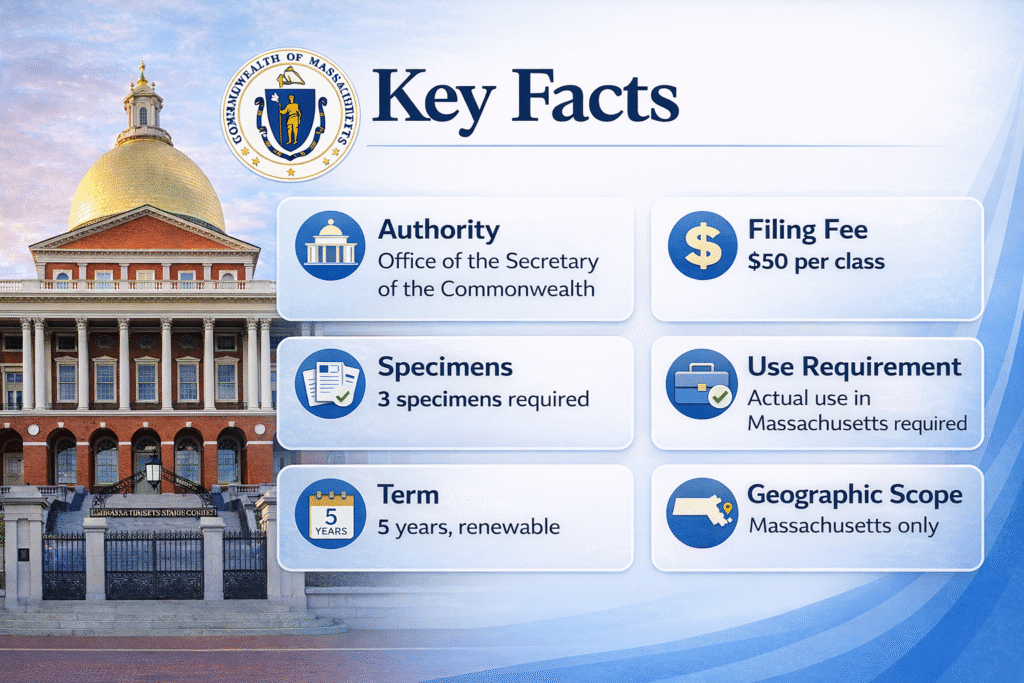
Key Facts
- Authority: Office of the Secretary of the Commonwealth – Corporations Division (Trademarks & Service Marks).
- Application form: Massachusetts Trademark / Service Mark Application (official state form).
- Filing method: By mail or in person.
- Filing fee: USD $50 per class.
- Specimens: Three specimens or facsimiles of the mark as actually used in commerce.
- Use requirement: The mark must be in actual use in Massachusetts at the time of filing.
- Term: 5 years, renewable for additional 5-year terms.
- Scope: Protection only within Massachusetts.
- Federal alternative: USPTO application fees typically range from $350–$550 per class.
If your business operates in multiple states or sells online nationwide, consider a federal U.S. trademark registration.
What is a Massachusetts state trademark?
A Massachusetts state trademark (or service mark) is a word, name, symbol, logo, or combination registered with the Secretary of the Commonwealth for use in connection with specific goods or services. Registration:
- creates a public record of ownership,
- provides constructive notice within the Commonwealth,
- strengthens your enforcement position under Massachusetts trademark law.
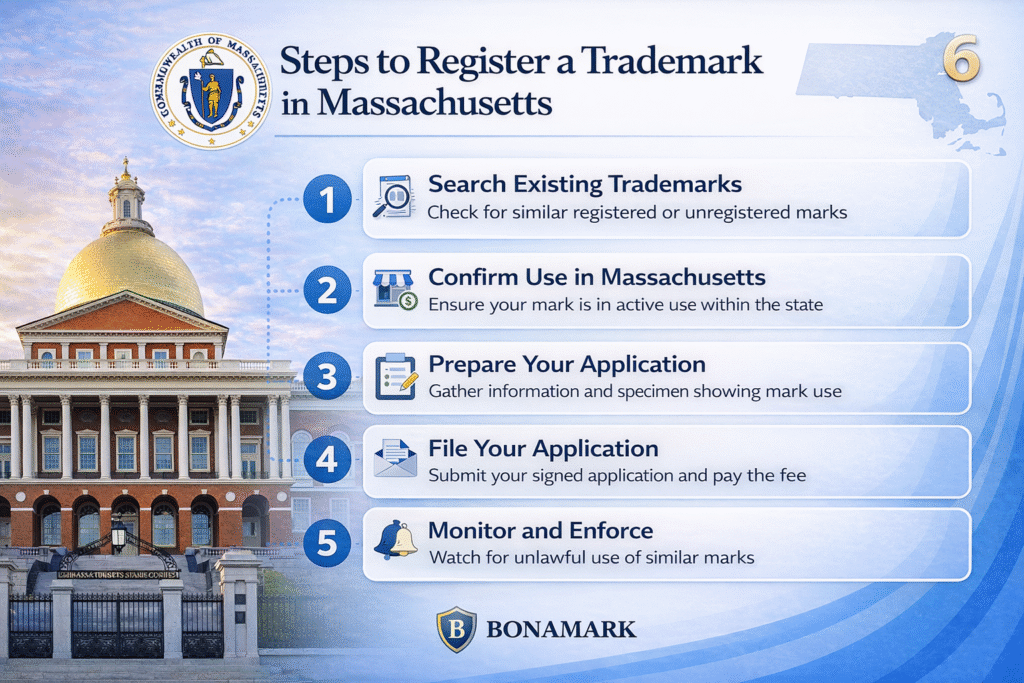
Step 1: Search existing trademarks in Massachusetts
Before filing, search to ensure your proposed mark does not conflict with an existing one.
A proper Massachusetts trademark search should begin with reviewing state trademark records maintained by the Office of the Secretary of the Commonwealth. This search helps identify existing Massachusetts state trademark and service mark registrations that could conflict with your proposed mark at the state level.
However, a Massachusetts trademark search should not be limited to state records alone. A complete search also includes federal trademark registrations and pending applications, as well as common-law uses that may not appear in official databases. Reviewing both state and federal sources reduces the risk of conflicts and helps determine whether your mark can be safely used and registered.
- Search the Massachusetts state trademark database
- exact matches,
- similar spellings and pronunciations,
- abbreviations, acronyms and variants,
- similar logos or design elements.
- Search beyond the state registry
- USPTO TESS for federal trademarks,
- domains and social media usernames,
- search engines for unregistered (common law) uses.
- Assess potential conflicts
If similar marks exist for related goods/services, consider modifying your proposed mark before filing.
Step 2: Confirm that your mark is in use in Massachusetts
Massachusetts requires actual use in commerce before filing. “Use” means:
- Goods: mark appears on labels, packaging, tags or products sold in the Commonwealth.
- Services: mark appears in ads, websites, signage, brochures or other materials promoting services rendered in Massachusetts.
You must provide first-use anywhere and first-use in Massachusetts dates.
Step 3: Prepare your Massachusetts trademark application
The application will require:
- Owner information (individual or entity, address, formation details if applicable),
- Description of the mark (words, stylization, design elements),
- Goods/services description associated with the mark,
- Classification based on international classes,
- First-use dates,
- Information about prior filings,
- Three specimens of the mark as used,
- Signature and verification of ownership and accuracy.
Specimen requirements
The application must include three specimens or facsimiles showing how the mark is used in commerce. Examples include:
- labels, packaging or tags,
- product photographs, store displays or signage,
- printed ads, brochures or marketing materials,
- website screenshots showing the mark offered with goods/services and customer action options.
Step 4: File your application
Submit the completed form, three specimens and the filing fee to the Corporations Division.
- Check accuracy of all information.
- Attach three specimens showing the mark as used.
- Pay the fee of $50 per class.
- File by mail or in person to the Secretary of the Commonwealth.
The filing is reviewed for completeness, registrability and potential conflicts. If accepted, the state issues a Certificate of Registration with the mark details, owner information, class, first-use dates, and registration term.
Step 5: Use, monitor and enforce your trademark
Use the mark consistently
- Use the mark as registered.
- Avoid significant alterations without re-filing.
- Keep updated records of ongoing use.
Monitor the market
- Watch local competitors for similar marks.
- Monitor online platforms and marketplaces.
- Address issues early to prevent confusion.
Enforcement tools
- Cease-and-desist letters,
- coexistence or settlement agreements,
- civil action under Massachusetts trademark law.
Step 6: Renewal and maintenance
A Massachusetts trademark registration is valid for 5 years and can be renewed for additional 5-year periods.
To renew, you must:
- file a renewal application within the 6-month window before expiration,
- pay the renewal fee,
- provide a statement confirming continued use,
- attach a current specimen of use.
Failure to renew results in expiration and loss of priority.
Massachusetts state trademark vs federal USPTO trademark
| Feature | Massachusetts State Trademark | Federal (USPTO) Trademark |
|---|---|---|
| Scope | Massachusetts only | Nationwide |
| Authority | Secretary of the Commonwealth | United States Patent and Trademark Office (USPTO) |
| Filing fee | $50 per class | $350–$550 per class |
| Term | 5 years (renewable) | 10 years (renewable) |
| Best for | Local Massachusetts brands | Businesses operating nationally or online |
Frequently Asked Questions
Do I need a Massachusetts trademark to have rights?
No. Common-law rights arise through use. However, registration provides stronger legal protection and public notice.
How many specimens are required?
You must submit three specimens or facsimiles showing current use of the mark.
How long does a Massachusetts registration last?
It is valid for 5 years and renewable for additional 5-year terms.
Can I file if I am not yet using the mark?
No. Massachusetts requires actual use at the time of filing.
When should I choose a federal USPTO registration?
If you sell or plan to sell in multiple states, operate online, or need stronger nationwide protection, a federal registration is recommended.
- Trademark registration
- USA
- U.S. states guide
Trademark services in the United States