


















A trademark assignment transfers ownership of a trademark to a different legal owner. A trademark name change updates the owner’s name when the same legal entity still owns the trademark.
This difference matters because filing the wrong ownership update can create confusion in the public trademark record. It can also cause problems during renewals, enforcement, licensing, acquisitions, Amazon Brand Registry verification, and future trademark transfers.
Businesses often face this issue after a company sale, merger, asset purchase, corporate restructuring, rebrand, or legal name update. The right filing depends on one central question: did the trademark move to a new legal owner, or did the same owner simply change its name?
If you are still reviewing the broader filing process, see our guide on how trademark ownership is established in the United States.
Quick Summary
Use a trademark assignment when trademark ownership moves from one legal entity to another. Use a name change when the same legal entity keeps ownership but changes its legal name. If the wrong update is filed, the trademark record may not accurately reflect ownership, which can cause avoidable problems later.
Assignment vs. name change — key facts
- A trademark assignment changes the legal owner of a trademark.
- A name change updates the name of the same trademark owner.
- Assignments are common in sales, mergers, acquisitions, and asset transfers.
- Name changes are common after corporate renaming or entity record updates.
- Both updates may need to be recorded so the public trademark record stays accurate.
- The wrong filing can create ownership gaps or due diligence issues.
What is a trademark assignment?
A trademark assignment is a transfer of ownership from one party to another. The current owner transfers trademark rights to a new owner, usually through a written assignment agreement.
Assignments are commonly used when:
- a business sells a brand;
- a company acquires another company;
- a trademark is included in an asset purchase;
- a startup transfers IP to a parent company;
- a founder transfers a mark to a company;
- or a trademark portfolio is reorganized between related entities.
A trademark assignment should usually transfer the goodwill connected with the mark. That means the trademark should not be treated as a disconnected word or logo. It represents brand reputation, customer recognition, and commercial identity associated with goods or services.
After the assignment is signed, the ownership change is commonly recorded with the USPTO. Businesses can use the USPTO Assignment Center to record a trademark assignment and update the public assignment record.
What is a trademark owner name change?
A trademark owner name change is used when the same legal owner continues to own the trademark but its legal name has changed.
For example, a company may change its legal name from “ABC Products LLC” to “ABC Brands LLC.” If the same legal entity continues to exist and own the trademark, this is usually a name change rather than an assignment.
Name changes are commonly used when:
- a company changes its legal name;
- a corporation updates its entity name after rebranding;
- an LLC changes its registered legal name;
- or public records need to match updated business documents.
A name change does not transfer trademark rights to a different owner. It only updates how the same owner appears in the public record.
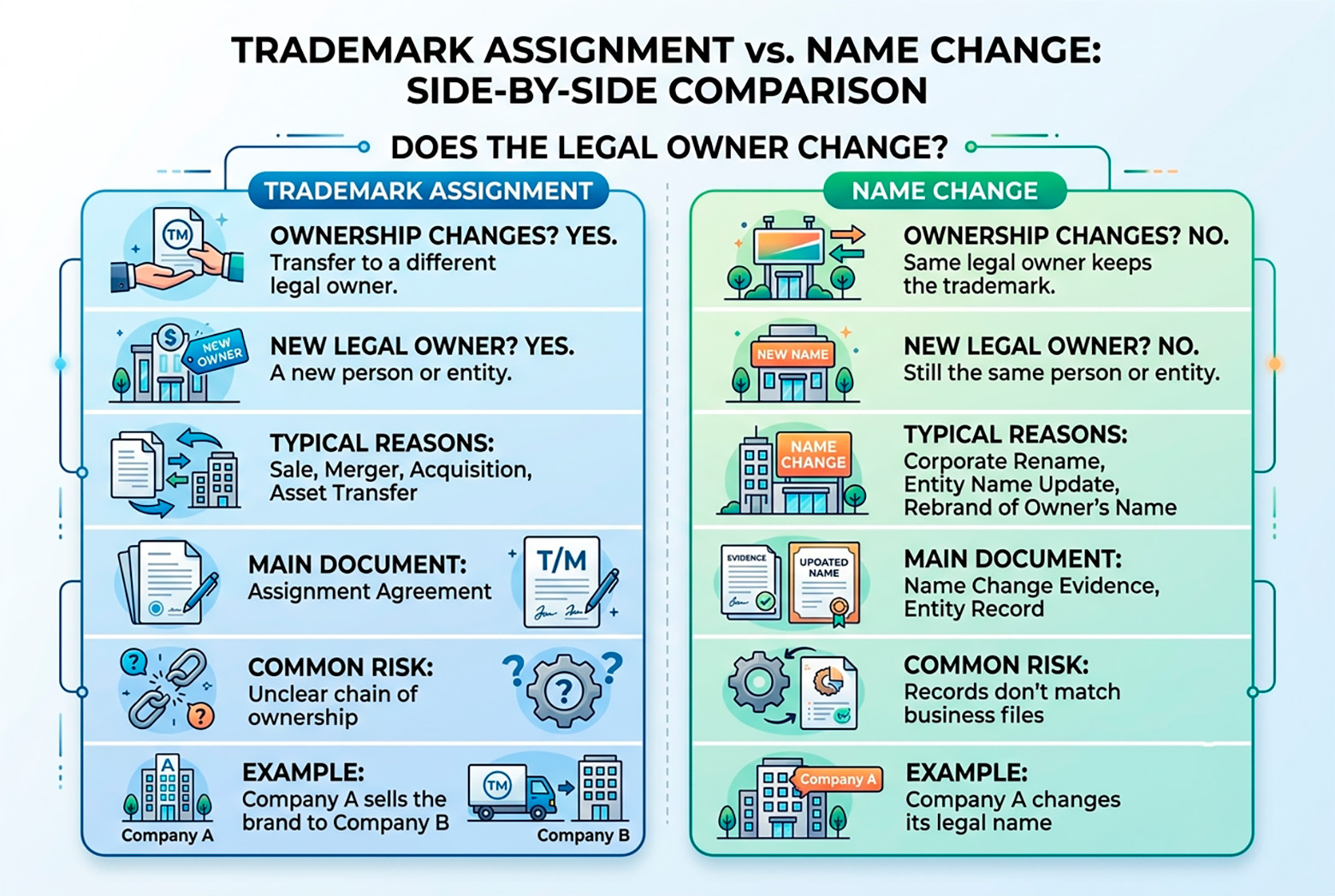
Trademark assignment vs. name change: side-by-side comparison
The simplest way to choose the correct filing is to ask whether the legal owner changed.
| Issue | Trademark assignment | Name change |
|---|---|---|
| Ownership changes? | Yes. The trademark moves to a different legal owner. | No. The same legal owner keeps the trademark. |
| New legal owner? | Yes. | No. |
| Typical reason | Sale, acquisition, merger, asset transfer, portfolio restructuring. | Corporate rename, entity name update, rebrand of the owner’s legal name. |
| Main document | Trademark assignment agreement. | Name change evidence or entity record showing the updated name. |
| Common risk | Ownership chain becomes unclear if not recorded properly. | Trademark record may not match current business records. |
| Example | Company A sells the brand to Company B. | Company A changes its legal name but remains the owner. |
When should you file a trademark assignment?
You should usually file a trademark assignment when the trademark changes hands from one legal person or entity to another.
This may happen when a trademark is transferred as part of:
- a business acquisition;
- an asset purchase agreement;
- a merger;
- a corporate restructuring involving different legal entities;
- a transfer from an individual founder to a company;
- a sale of a product line;
- or a transfer between affiliated companies.
If the trademark owner before and after the transaction is not the same legal entity, an assignment is usually the correct path.
When is a name change enough?
A name change may be enough when the trademark owner remains the same legal entity and only its name changes.
Common examples include:
- an LLC changes its registered legal name;
- a corporation rebrands its company name;
- a company updates its name after a reorganization but remains the same legal entity;
- or the owner corrects a formal name mismatch in public records.
The important point is continuity. If the same entity continues to own the trademark, the update is usually not an assignment.
Real-world example: business sale vs. corporate name update
Imagine two different situations involving the same brand.
Scenario 1: business sale
Company A sells its product brand to Company B. Company B will now own and operate the brand. This usually requires a trademark assignment because ownership moves from one legal owner to another.
Scenario 2: corporate name update
Company A changes its legal name from “BrightGoods LLC” to “BrightGoods Brands LLC.” The same entity continues to exist and own the trademark. This is usually a name change, not an assignment.
Both situations may require the public trademark record to be updated, but the legal basis is different.
Can the wrong filing create problems?
Yes. Filing an assignment when a name change is required, or treating an ownership transfer as a simple name change, can create confusion in the trademark record.
- unclear ownership history;
- difficulty proving ownership during enforcement;
- delays during trademark renewal or maintenance filings;
- problems during mergers, acquisitions, or investor due diligence;
- Amazon Brand Registry verification issues;
- licensing problems;
- or the need to correct public records later.
Ownership records should be clear enough that a third party can understand who owns the trademark and how ownership changed over time.
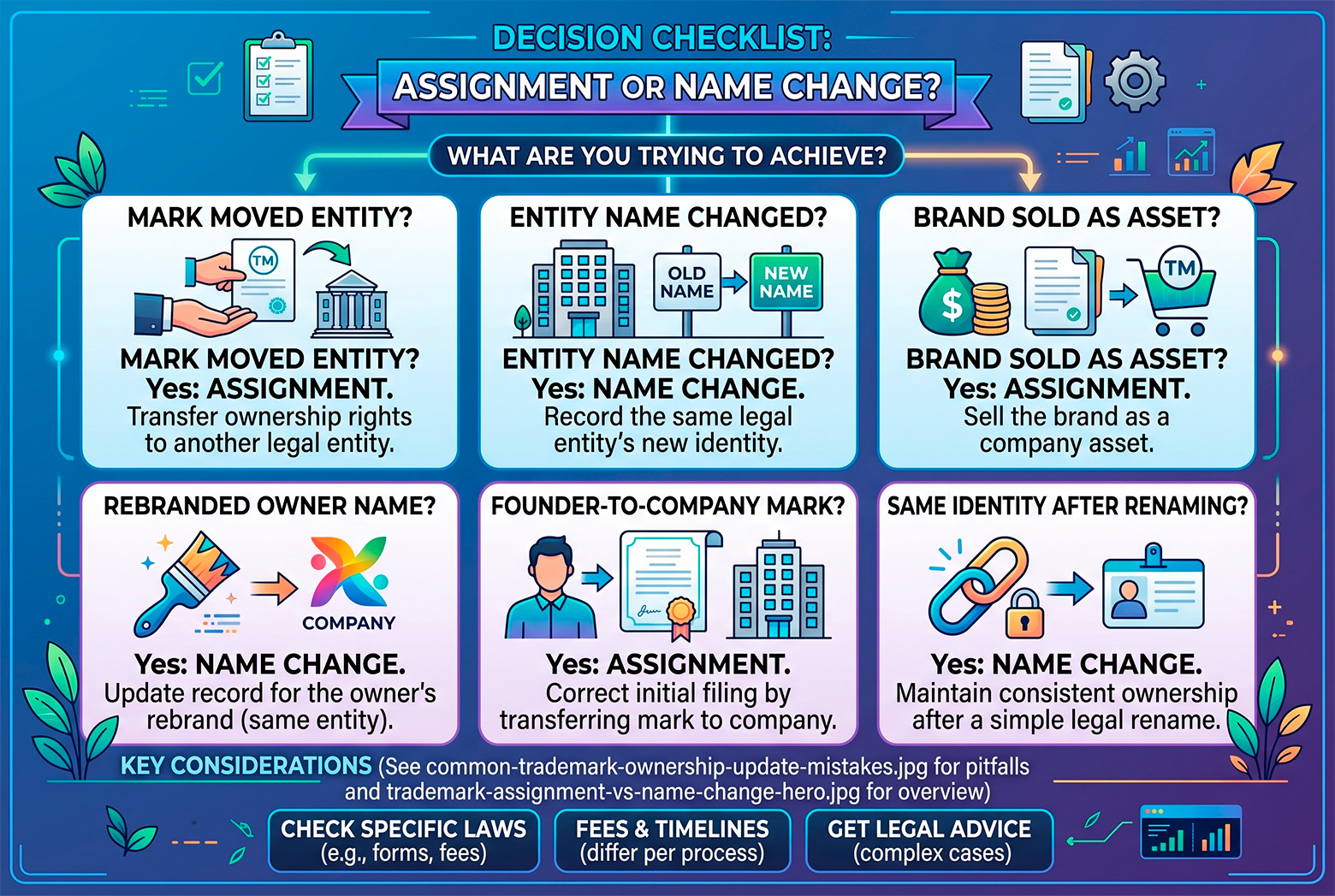
How to decide which filing you need
The decision usually depends on legal identity, not only on branding or business wording.
| Question | If yes | Likely filing |
|---|---|---|
| Did the trademark move to a different legal entity? | Yes | Assignment |
| Did the same legal entity simply change its name? | Yes | Name change |
| Was the brand sold as an asset? | Yes | Assignment |
| Was there only a rebrand of the owner’s legal name? | Yes | Name change |
| Was the mark transferred from a founder to a company? | Yes | Assignment |
| Did the company keep the same legal identity after renaming? | Yes | Name change |
If the answer is still unclear, businesses should review the transaction documents, corporate records, and USPTO owner information before filing. A trademark search can also help identify related marks, ownership history, and potential conflicts before a record update is submitted.
What documents are usually needed?
The required documents depend on whether the update is an assignment or a name change.
| Filing type | Typical documents | What they prove |
|---|---|---|
| Trademark assignment | Assignment agreement, asset purchase agreement, merger documents, signed transfer documents. | The trademark rights moved from one owner to another. |
| Name change | Corporate name change certificate, amended entity record, official business registry evidence. | The same legal owner changed its name. |
For assignments, the document should clearly identify the trademark and the parties. For name changes, the evidence should show continuity of the same legal owner.
How to update USPTO trademark ownership records
Ownership updates are typically recorded through USPTO systems. The public assignment records can later be used to review ownership history and confirm whether recordation appears correctly.
Before submitting an update, businesses should:
- confirm the current owner shown in the USPTO record;
- identify whether ownership changed or only the name changed;
- prepare the correct supporting documents;
- check registration or application numbers;
- confirm entity names and addresses;
- and keep signed copies for internal records.
After the recordation is processed, the owner should verify that the public trademark record reflects the update correctly.
Assignment vs. name change in mergers and acquisitions
Mergers and acquisitions often create confusion because ownership changes may happen through several legal steps.
In an asset purchase, trademarks are usually transferred through an assignment. In a merger, the surviving entity may need to record changes depending on the transaction structure. In a corporate rename, a name change may be sufficient if the same entity continues to own the mark.
Businesses should not rely only on commercial language such as “brand transfer” or “company rebrand.” The correct filing depends on the legal transaction and the identity of the trademark owner before and after the event.
Assignment vs. name change for Amazon Brand Registry
Amazon Brand Registry often checks trademark ownership against trademark office records. If the brand owner shown in Amazon does not match the trademark owner in public records, verification can become more difficult.
A trademark assignment may be needed if the brand moved to a new owner. A name change may be enough if the same owner changed its legal name. Either way, the trademark record should be consistent with the business information submitted to Amazon.
This is especially important for sellers that acquired a brand, changed corporate entities, or moved ownership between related companies before enrolling in Amazon Brand Registry.
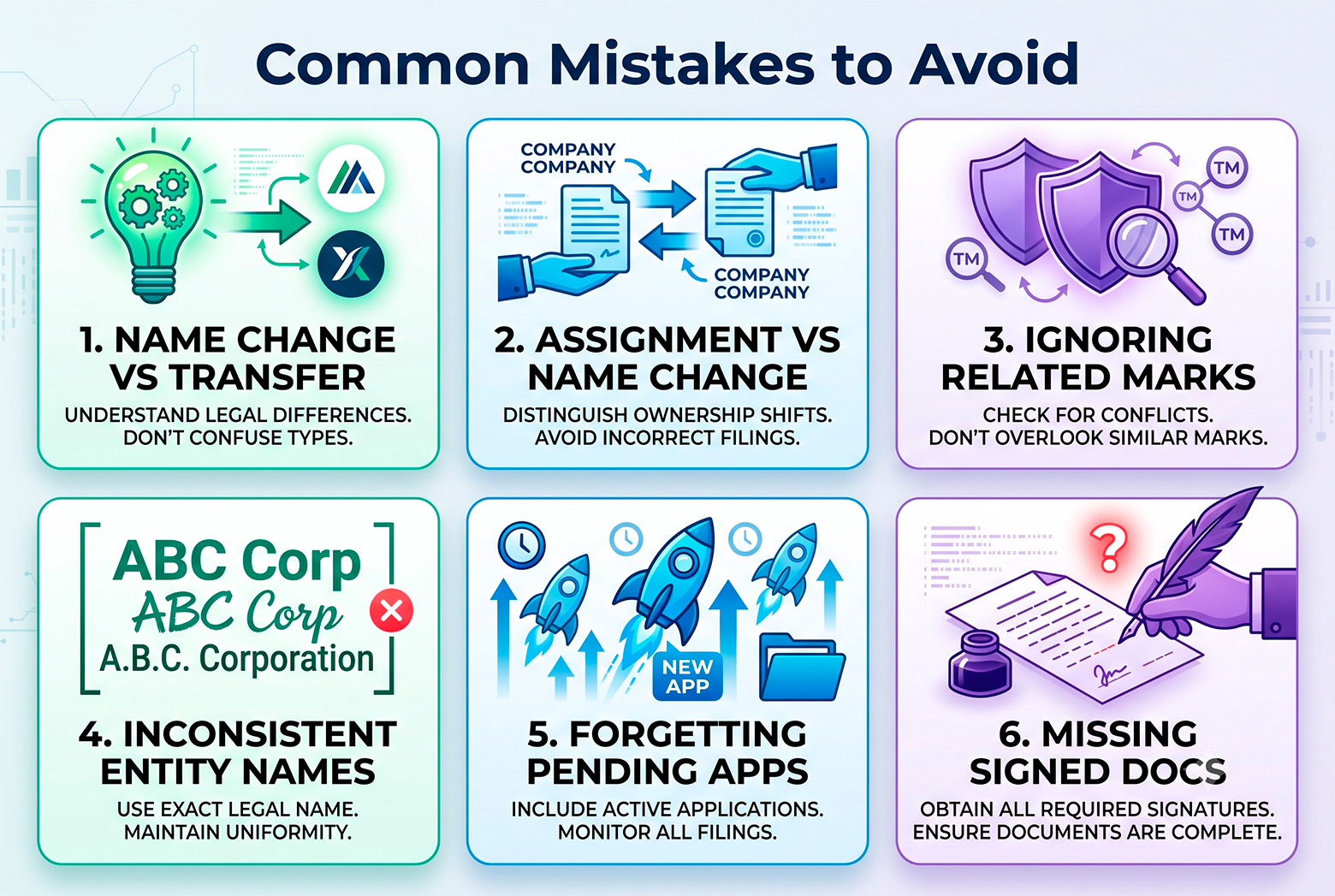
Common mistakes to avoid
1. Filing a name change when ownership actually transferred
This can leave the true ownership chain unclear and may cause problems later.
2. Filing an assignment when the owner only changed its name
This may create unnecessary confusion because no ownership transfer occurred.
3. Ignoring related trademarks
A transaction may include word marks, logos, slogans, product names, and pending applications. All relevant marks should be reviewed, especially when similar marks could create likelihood of confusion concerns.
4. Using inconsistent entity names
Business records, trademark records, and transaction documents should use consistent legal names whenever possible.
5. Forgetting pending applications
Pending applications may need to be included in ownership updates, especially during acquisitions or portfolio transfers. If an application has received an examining attorney issue, review the USPTO Office Action response process before making ownership changes.
6. Not keeping signed documents
USPTO recordation is important, but businesses should also keep signed agreements and corporate records.
Should you get help before filing?
Professional assistance can be helpful when the ownership history is unclear, the transaction involves multiple marks, the mark is part of an acquisition, or the owner record does not match current business documents.
Bonamark offers trademark registration, ownership review, and record update support for businesses managing trademark portfolios in the United States and internationally.
Final thoughts
The difference between a trademark assignment and a name change depends on whether ownership changed. If the trademark moved to a new legal owner, an assignment is usually needed. If the same owner simply changed its legal name, a name change may be enough.
Choosing the correct filing helps keep the public trademark record accurate and reduces the risk of problems during enforcement, renewal, licensing, acquisitions, Amazon Brand Registry verification, trademark monitoring, and future ownership transfers.
Contact Bonamark to ensure your trademark is filed correctly. Our consultants can guide you through trademark ownership review, assignment strategy, and record update support.
FAQ
Is a trademark assignment the same as a name change?
No. A trademark assignment transfers ownership to a different legal owner. A name change updates the name of the same legal owner.
When do I need a trademark assignment?
You usually need a trademark assignment when a trademark is sold, acquired, transferred between entities, or included in a business or asset transaction.
When is a name change enough?
A name change is usually enough when the same legal entity continues to own the trademark but has changed its official legal name.
Can filing the wrong update create problems?
Yes. The wrong filing can create ownership confusion, delay future filings, and complicate enforcement, licensing, or due diligence.
Does Amazon Brand Registry care about trademark ownership records?
Yes. Amazon may compare brand ownership information with trademark office records, so inaccurate owner records can complicate verification.
Can a pending trademark application be assigned?
Often yes, but pending applications, especially intent-to-use applications, should be reviewed carefully before transfer.
- Trademark registration
- USPTO
- Trademark Search
- Trademark Clearance
- Likelihood of Confusion
Trademark services in the United States


