















When companies engage in mergers and acquisitions (M&A), intellectual property is rarely a secondary issue. In many transactions, it represents a core value driver. Yet IP-related challenges frequently emerge at every stage of the deal process — from due diligence to post-closing integration.
These risks can be grouped into five principal categories.
1. Due Diligence: What Is Actually Being Acquired?
The first question is deceptively simple:
What intellectual property does the target company truly own?
Key issues include:
- Whether IP rights are properly assigned to the target entity
- Whether registrations remain valid and enforceable
- Whether renewal deadlines have been properly maintained
A trademark may appear “active” in an official register while being commercially weakened due to prolonged non-enforcement. A patent may be formally valid but practically unenforceable due to procedural defects.
Surface-level review is insufficient. IP validity must be tested against actual enforceability.

2. Chain of Title and Ownership Defects
Ownership is not assumed — it must be proven.
In some transactions, IP assets are held by affiliated entities, founders, or related companies and were never properly assigned to the operating company. In other cases, historical transfers were signed but never recorded.
Chain-of-title defects compound over time.
What could have been corrected through a simple assignment early in the lifecycle can later evolve into a multi-jurisdictional rectification process requiring:
- notarizations
- legalization
- confirmatory assignments
- recordal procedures
- and, in certain jurisdictions, court involvement
In M&A, certainty of title is not a technicality — it directly affects valuation.
3. Encumbrances and Restrictions on IP Assets
Ownership does not automatically equal control.
Pre-existing agreements may significantly restrict the acquirer’s freedom to operate or monetize the asset. These may include:
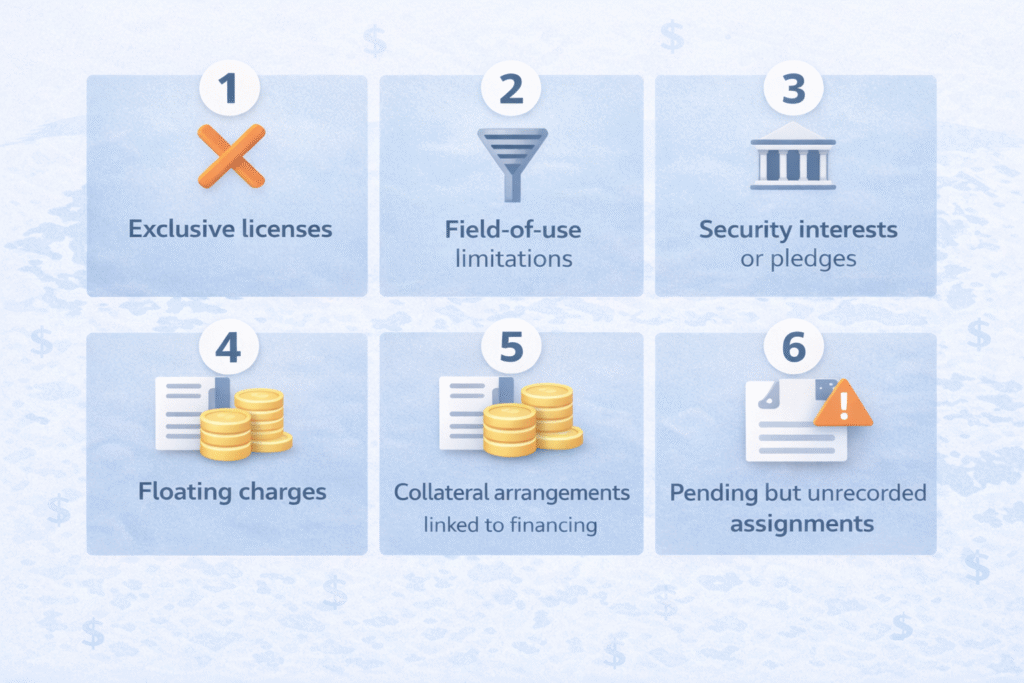
- exclusive licenses
- field-of-use limitations
- security interests or pledges
- floating charges
- collateral arrangements linked to financing
- pending but unrecorded assignments
For example:
- An exclusive license granted years earlier may survive the transaction and block entry into strategic markets.
- A security interest in favor of a financial institution may require prior consent before transfer.
- An unrecorded assignment may create competing ownership claims.
The economic consequence is clear: ownership without control is illusory.
4. Post-Closing Integration Risks
Even when due diligence appears thorough, post-closing integration introduces additional complexity.
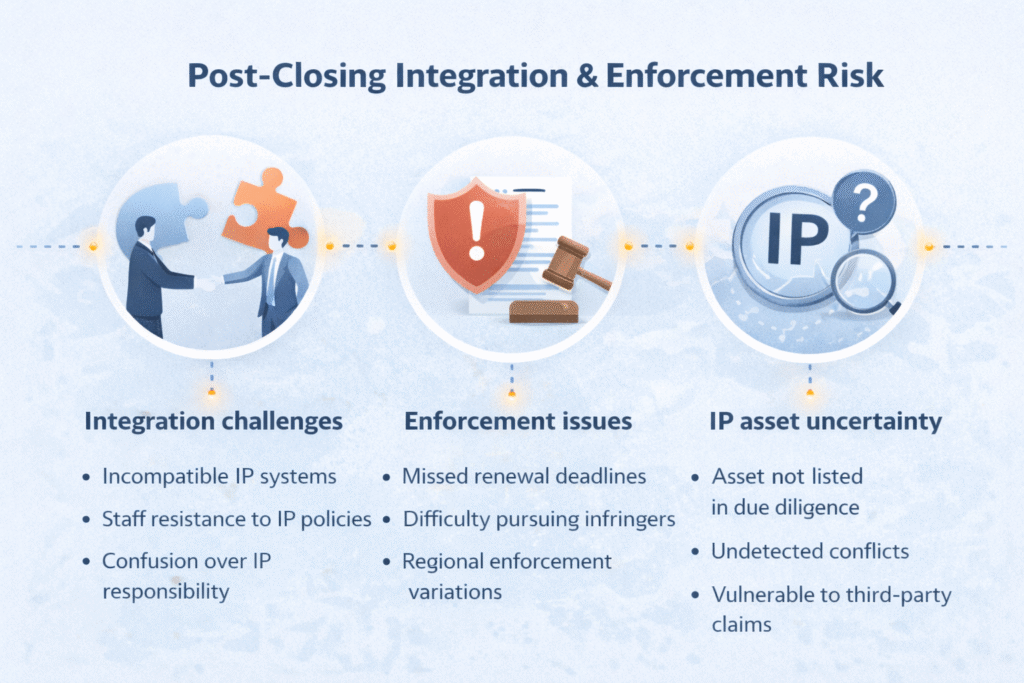
Questions that often arise include:
- Are renewal deadlines synchronized across jurisdictions?
- Are IP management systems centralized?
- Is the acquired portfolio aligned with the buyer’s global filing strategy?
Acquired IP portfolios are frequently fragmented across multiple agents and jurisdictions, with inconsistent data, overlapping registrations, and varying protection quality.
Without consolidation and harmonization, the acquirer inherits administrative inefficiency and increased risk exposure.
Strategic alignment must also be assessed. Overlapping trademarks may create internal brand conflicts. Certain assets may require rebranding to avoid external conflicts in new markets.
5. Valuation and Strategic Relevance
Not all IP assets carry equal weight.
A portfolio may appear impressive in volume — hundreds of registrations across dozens of jurisdictions — yet commercial value depends on:
- geographic relevance
- product alignment
- enforcement history
- competitive positioning
- market perception
A trademark registered in 40 jurisdictions but actively used in only three may not justify ongoing maintenance costs across all territories. Conversely, a single patent protecting a critical technological bottleneck may represent the entire strategic advantage of the target.
The central question is not only whether the asset is valid — but whether it is essential.
6. Risk Allocation in Transaction Documents
No due diligence process eliminates uncertainty entirely.
Therefore, contractual safeguards play a decisive role.
Transaction documentation should include carefully drafted:
- representations and warranties regarding ownership, validity, and non-infringement
- disclosure schedules covering encumbrances and disputes
- indemnification provisions addressing third-party claims
- escrow mechanisms or purchase price adjustments where IP risk is material
In technology-driven transactions, additional protections may be required, including indemnities relating to open-source compliance or employee invention claims.
Conclusion
Intellectual property in M&A is not a checklist item — it is frequently the foundation of the deal.
A trademark weakened by non-enforcement, a patent with a defective chain of title, an unrecorded assignment, or a buried exclusive license can fundamentally alter the economics of a transaction.
The distinction between a successful acquisition and a post-closing dispute often lies in the precision of IP analysis.
In M&A, ownership must be demonstrable, control must be operational, and value must be defensible. Anything less transforms acquisition into assumption of risk.
Vladimir Isaev
EUIPO Trademark Representative
FAQ
Why is intellectual property due diligence important in M&A transactions?
IP due diligence helps buyers confirm what IP assets exist, who owns them, how they are protected, and whether they carry risks or liabilities that could affect deal value.
What types of IP assets should be reviewed in M&A due diligence?
Due diligence typically covers trademarks, patents, copyrights, design rights, trade secrets, and in some cases domain names or software code.
What are common risks if IP due diligence is inadequate?
Inadequate review can lead to undiscovered ownership defects, incomplete registrations, litigation, or limitations on the use of IP that reduce the value or usability of assets post-closing.
Can generic names like “Urban T-Shirt” be trademarked?
Yes. For example, a trademark not properly owned by the entity being acquired or restricted by licenses may not transfer cleanly in an M&A transaction.
How does IP due diligence help with valuation in M&A?
A strong IP portfolio that is valid, enforceable, and aligned with the business model can significantly enhance company valuation and attractiveness to buyers.
What happens when ownership records of IP are unclear?
If chain-of-title is incomplete, a buyer may be forced to rectify ownership later — a process that can be costly and time-consuming, or even prevent the intellectual property from being included in the deal.
Does IP due diligence only focus on registered rights?
No. Due diligence also often includes unregistered rights such as trade secrets and confidential information, particularly where those rights are critical to business operations.
What role can an IP partner play in supporting M&A due diligence?
An experienced IP partner can assist buyer firms by conducting detailed review, flagging risks, and advising on mechanisms for mitigation in transaction documentation.
- IP Protection
Trademark services in the United States