













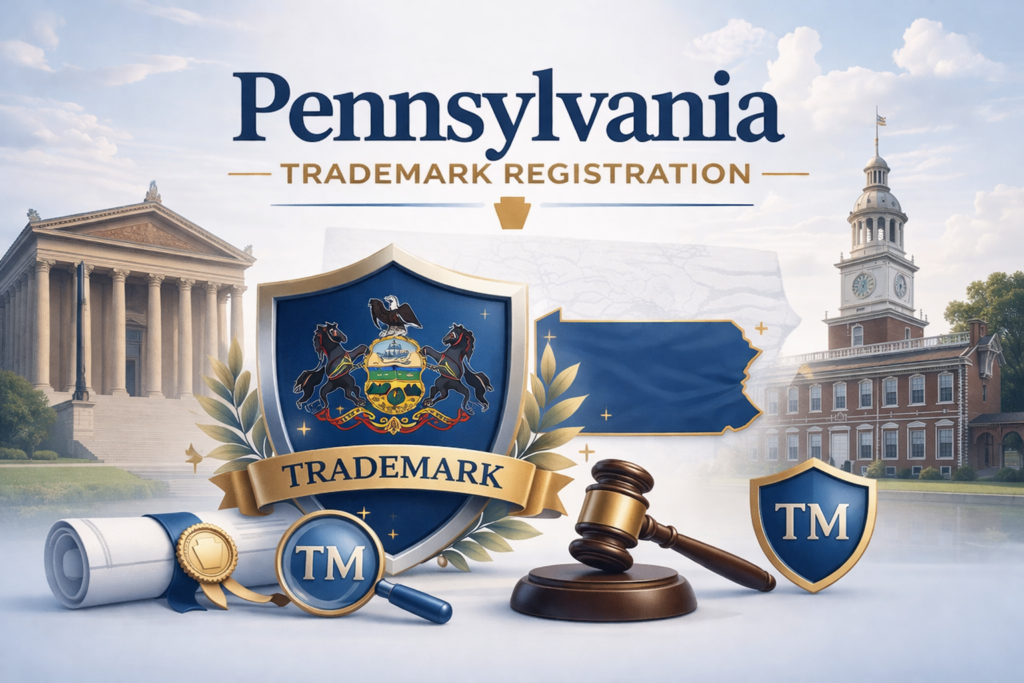
If your business operates in Pennsylvania and uses a brand name, logo, or slogan within the state, registering a trademark at the state level can help protect those rights locally. A Pennsylvania state trademark does not replace a federal U.S. trademark registration, but it can be a practical option for businesses focused primarily on the Pennsylvania market.
This guide explains how to register a trademark in Pennsylvania, what the Pennsylvania Department of State requires, how the filing process works in practice, and when it may make sense to pursue federal protection instead of, or in addition to, a Pennsylvania state registration.
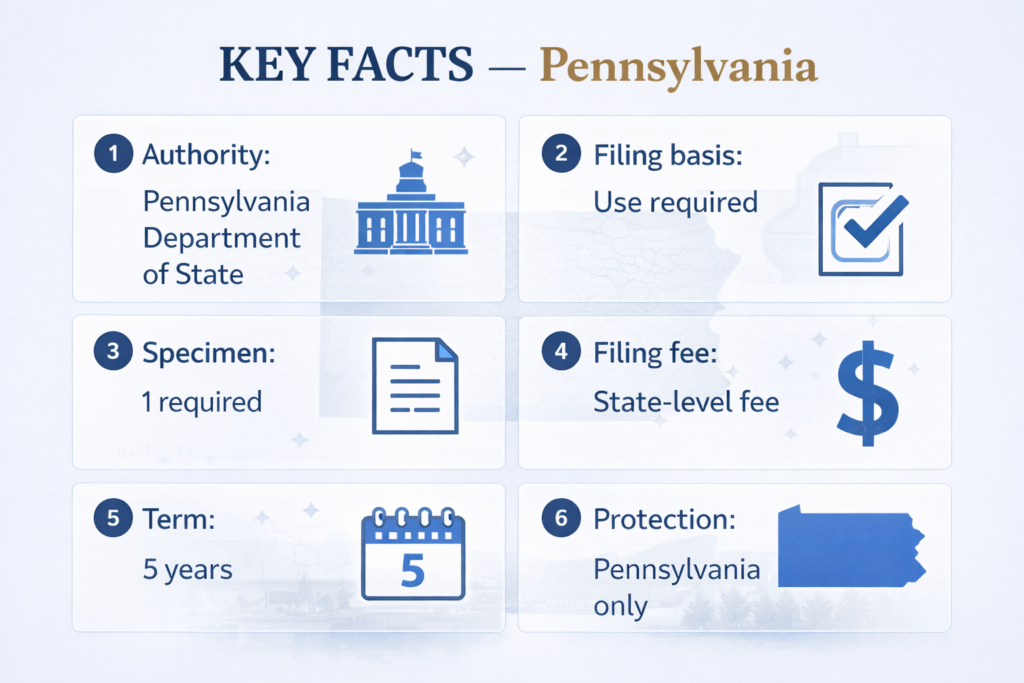
Key Facts (Pennsylvania)
- Authority: Pennsylvania Department of State
- Application type: State trademark or service mark
- Filing fee: State-level filing fee per application (non-refundable)
- Specimen: At least one specimen of use is required
- Use requirement: The mark must already be in actual use in Pennsylvania commerce
- Term: 5 years from registration; renewable for additional 5-year periods if the mark remains in use
- Geographic scope: Protection limited to the Commonwealth of Pennsylvania
- Federal alternative: For nationwide protection, USPTO filing fees typically range from $350 to $550 per class, depending on the filing option
If your business sells across state lines, operates nationally online, or plans to expand beyond Pennsylvania, federal trademark registration is often the stronger long-term option.
What Is a Pennsylvania State Trademark?
A Pennsylvania state trademark (or service mark) is a word, name, symbol, logo, or combination registered with the Pennsylvania Department of State for use in connection with specific goods or services within Pennsylvania.
Registering a trademark in Pennsylvania:
- creates a public record of your claim to the mark in Pennsylvania,
- helps prevent others in the state from adopting confusingly similar marks,
- strengthens your position in cease-and-desist letters and state-level enforcement actions.
However, a Pennsylvania registration does not automatically protect your brand outside the state. For broader protection, a separate federal trademark registration with the United States Patent and Trademark Office (USPTO) is usually required.
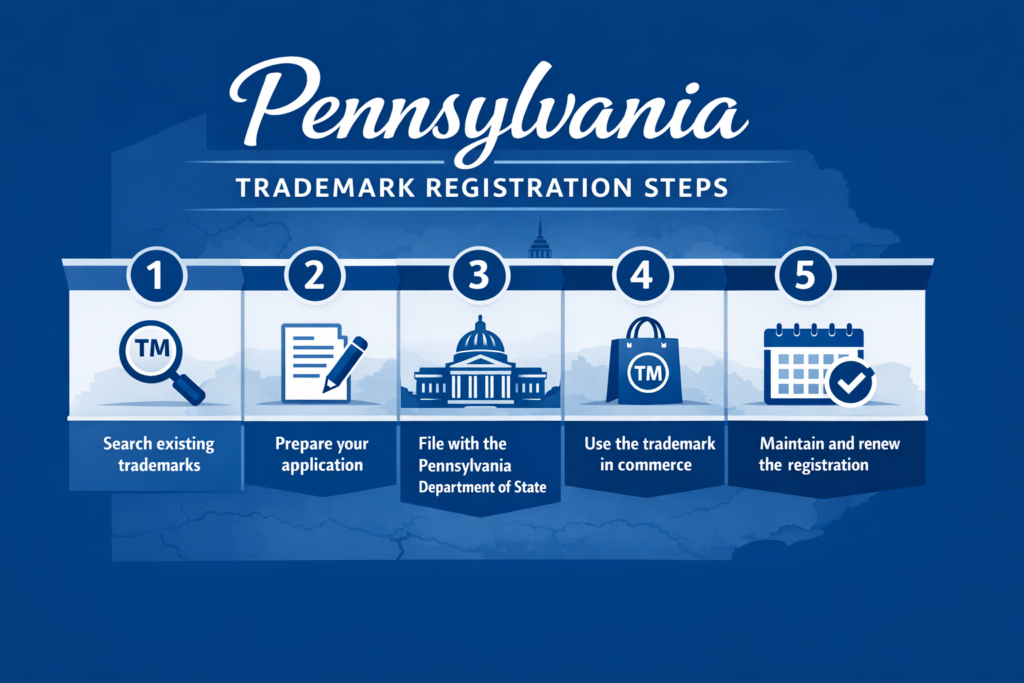
Step 1: Search Existing Trademarks in Pennsylvania
Before filing, conducting a Pennsylvania trademark search is essential to confirm that your proposed mark is available and not already in use for related goods or services.
Search Pennsylvania trademark records
The Pennsylvania Department of State maintains records of state trademark and service mark registrations. When reviewing existing registrations, look for:
- exact matches to your proposed mark
- similar spellings or phonetic equivalents
- abbreviations or shortened versions
- marks covering related or overlapping goods or services
Search beyond the state registry
Even if the Pennsylvania database appears clear, you should also search:
- federal trademark registrations and applications
- business names and assumed names
- domain name registrations
- social media platforms and online marketplaces
- general web search results for common-law uses
Assess the risk
If similar marks exist for related goods or services, filing may lead to refusal or future disputes. In close cases, modifying the mark early can be significantly cheaper than rebranding later.
Bonamark offers professional trademark search services that combine Pennsylvania state records, federal trademark data, and common-law sources to help assess risk before filing.
Step 2: Confirm Use of the Mark in Pennsylvania
Pennsylvania is a use-based jurisdiction for state trademark registration. You cannot file a Pennsylvania application based solely on an intent to use a mark in the future.
The mark must already be in actual use in Pennsylvania commerce at the time of filing.
For goods
The mark should appear on:
- the products themselves
- labels, packaging, or tags
- point-of-sale displays for goods sold or distributed in Pennsylvania
For services
The mark should be used in:
- advertising or marketing materials
- websites promoting services rendered in Pennsylvania
- invoices, contracts, signage, or similar materials
You should document how, where, and since when the mark has been used in Pennsylvania. This information is required for the application and future renewals.
Step 3: Prepare Your Pennsylvania Trademark Application
A Pennsylvania trademark application typically requires:
Owner details: individual or legal entity owning the mark
Type of mark: trademark (goods) or service mark (services)
Mark description:
- exact wording for word marks, or
- a clear description of the design for logos
Goods or services description: specific and accurate
Class or classes: Pennsylvania generally follows the international classification system
First-use dates:
- date of first use anywhere
- date of first use in Pennsylvania
Specimen of use: showing the mark as actually used in Pennsylvania commerce
Declaration and signature: confirming ownership and use of the mark
Errors in descriptions, dates, or specimens can delay processing or result in refusal.
Specimen Requirements (Pennsylvania)
The specimen must show the mark exactly as customers encounter it in real Pennsylvania commerce.
Common acceptable specimens include:
- product labels or packaging bearing the mark
- photographs of signage or displays used in Pennsylvania
- brochures, flyers, or advertisements showing the mark
- website screenshots clearly offering goods or services in Pennsylvania
The mark shown on the specimen must match the mark described in the application. Material differences can cause issues.
Step 4: File Your Application with the Pennsylvania Department of State
Once the application and specimen are complete, the filing is submitted to the Pennsylvania Department of State.
After submission, the application is reviewed to ensure:
- all required information is provided
- the mark meets state requirements
- there are no obvious conflicts with existing Pennsylvania registrations
If issues arise, you may be asked to provide clarification or corrections. Approved applications are entered into the Pennsylvania trademark registry.
Step 5: Use, Monitor, and Enforce Your Trademark
Registration alone does not automatically protect a brand. To maintain strong rights, you should:
Use the mark consistently
Use the mark in the same form as registered.
Avoid major changes without considering a new filing.
Maintain records of ongoing use in Pennsylvania.
Monitor the market
Watch competitors and new businesses in Pennsylvania.
Monitor online platforms where similar brands may appear.
Enforce your rights
If another party uses a confusingly similar mark in Pennsylvania, you may consider:
- sending a cease-and-desist letter
- negotiating coexistence or rebranding
- pursuing legal action under Pennsylvania trademark or unfair competition law
A state registration helps establish ownership and priority within Pennsylvania.
Step 6: Renewal and Maintenance (5-Year Term)
Under Pennsylvania law, a state trademark registration is valid for 5 years from the date of registration and may be renewed for successive 5-year periods as long as the mark remains in use.
Renewal typically requires:
- filing a renewal application
- payment of the required state fee
- confirmation of continued use
- submission of a current specimen
Failure to renew on time can result in cancellation and loss of priority.
Pennsylvania State Trademark vs Federal USPTO Registration
| Feature | Pennsylvania State Trademark | Federal Trademark |
|---|---|---|
| Geographic scope | Pennsylvania only | Nationwide (U.S.) |
| Authority | Pennsylvania Department of State | USPTO |
| Basis for filing | Actual use in Pennsylvania | Use or intent to use |
| Filing fees | State-level fee | $350–$550 per class |
| Term | 5 years, renewable | 10 years (with maintenance filings) |
| Best for | Local Pennsylvania businesses | Interstate or nationwide brands |
If your brand operates online, plans to expand beyond Pennsylvania, or licenses its name, combining state and federal registration may offer stronger protection.
How Bonamark Can Help
Trademark registration involves more than filing a form. Bonamark offers professional assistance with trademark searches, application preparation, and filing strategy at both the state and federal levels.
Contact Bonamark to ensure your trademark is filed correctly. Our consultants can guide you through Pennsylvania trademark registration and help you choose the right protection strategy.
Frequently Asked Questions — Pennsylvania Trademark Registration
Do I need to register a trademark in Pennsylvania to have rights?
No. Limited rights can arise from using a mark in Pennsylvania commerce under common law. However, state registration creates an official public record, strengthens enforcement options, and helps deter confusingly similar uses within the state.
Can I file a Pennsylvania trademark application if I am not yet using the mark?
No. Pennsylvania requires actual use of the mark in Pennsylvania commerce before filing. Intent-to-use applications are not accepted at the state level.
How long does a Pennsylvania state trademark last, and how do renewals work?
A Pennsylvania trademark registration is valid for 5 years from the date of registration and may be renewed for additional 5-year periods if the mark remains in use.
How many specimens are required for a Pennsylvania trademark application?
At least one specimen of use must be submitted with the application. The specimen must show how the mark is actually used in Pennsylvania commerce.
Is a business name or DBA the same as a trademark in Pennsylvania?
No. A business name identifies an entity, while a trademark identifies the source of specific goods or services. Registering a business name or DBA does not provide trademark protection.
When should I consider federal trademark registration instead of only a Pennsylvania filing?
Federal registration is usually appropriate if you sell goods or services outside Pennsylvania, operate an online business with customers in multiple states, or plan to expand nationally.
- Trademark registration
- USA
- U.S. states guide
Trademark services in the United States