













Registering a trademark in Vermont can help protect a business name, logo, slogan, or other brand identifier used in commerce within the state. A state trademark registration creates a public record of the owner’s claim to the mark and may help support enforcement against confusingly similar branding in Vermont.
State registration is not the same as federal registration through the United States Patent and Trademark Office (USPTO). A Vermont trademark generally protects the mark only within Vermont, while federal registration can provide nationwide rights and stronger tools for interstate commerce, online sales, licensing, and marketplace enforcement.
This guide explains how Vermont trademark registration works, how to conduct a Vermont trademark search, what specimens and fees are required, how renewal works, and when federal trademark registration may provide broader protection.
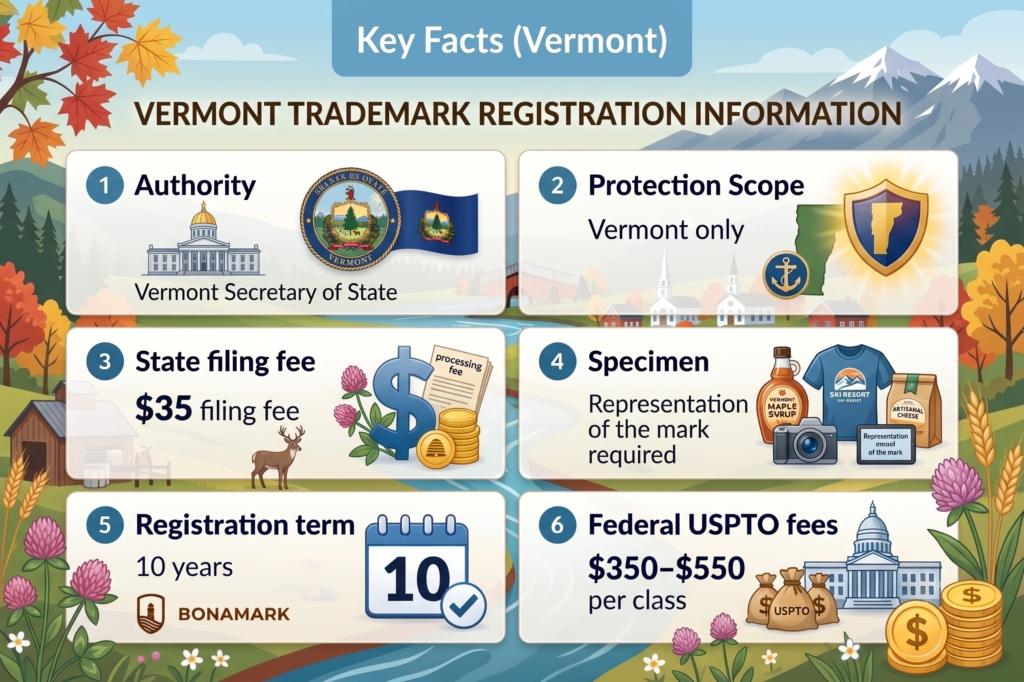
Key Facts About Vermont Trademark Registration
| Category | Details |
|---|---|
| Filing authority | Vermont Secretary of State |
| Protection scope | Vermont only |
| State filing fee | $35 filing fee |
| Specimen requirement | Representation of the mark required |
| Registration term | 10 years |
| Federal USPTO fees | $350–$550 per class |
What a Vermont Trademark Registration Protects
A trademark identifies the source of goods or services and helps distinguish one business from another. In Vermont, a trademark may protect a business name, product name, service brand, logo, slogan, or combined word-and-design mark when the mark is used in commerce.
The mark should be distinctive and should function as a brand identifier rather than a generic description of the goods or services. The stronger and more distinctive the mark is, the easier it is usually to protect and enforce.
What Cannot Usually Be Registered
Vermont may refuse a trademark application if the mark is generic, merely descriptive, deceptive, confusingly similar to an existing mark, or otherwise ineligible under state trademark rules. A state application also does not override earlier federal rights or common law rights created through prior commercial use.
Before filing, applicants should review the official state requirements through the Vermont Secretary of State business fees and statutes. For statutory context and renewal rules, applicants can also review Vermont Statutes Title 9, Chapter 71.
Why a Vermont trademark search Matters Before Filing
A trademark search is one of the most important steps before filing a state trademark application. A mark may appear available at first glance, but another business may already have a similar state registration, federal registration, trade name, domain, marketplace listing, or common law use that creates a conflict.
A proper Vermont trademark search should evaluate identical and similar marks, not only exact matches. Similar spelling, sound, meaning, appearance, or commercial impression may still create a likelihood of confusion.
For that reason, businesses often conduct both a state-level search and a broader federal search before investing in packaging, advertising, or a new brand launch. Bonamark’s trademark search service can help identify conflicts before an application is filed.
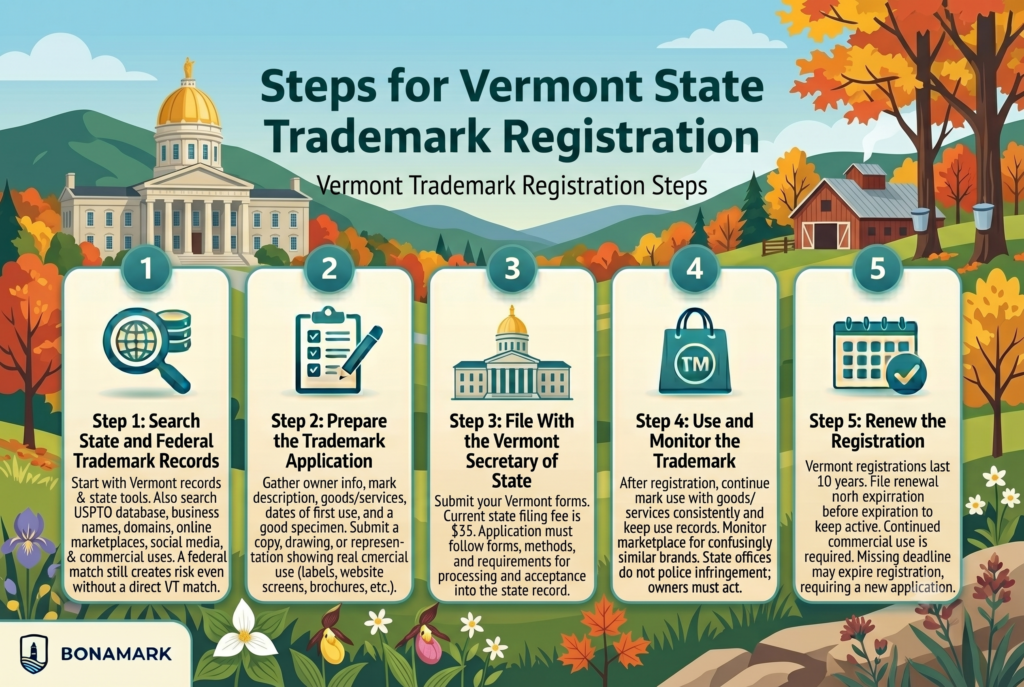
Step 1 — Search State and Federal Trademark Records
Start by reviewing Vermont trademark records and any state-level search tools made available by the filing authority. A state search can help identify marks already registered or recorded in Vermont.
State records are only one part of the clearance process. Applicants should also search the USPTO trademark database, business name records, domains, online marketplaces, social media, and other commercial uses. A federal registration or prior common law use may still create risk even when the state database does not show an exact match.
Step 2 — Prepare the Trademark Application
A Vermont trademark application generally requires the owner’s legal name and address, a description of the mark, the goods or services connected with the mark, dates of first use, and the required specimen materials. The application should describe the mark clearly and match the way the mark appears in actual commercial use.
For Vermont, applicants should be prepared to submit a copy, drawing, or other representation of the trademark, as required by the filing form and statute. A good specimen shows real use of the mark in connection with the listed goods or services. Examples may include product labels, packaging, tags, website screenshots with purchasing or service information, brochures, menus, advertisements, or other materials that show the mark being used as a brand.
Step 3 — File With the Vermont Secretary of State
Vermont trademark applications are filed with the Vermont Secretary of State. The current state filing fee is generally $35. Applicants should check the official filing page before submission because forms, filing methods, and administrative requirements can change.
After filing, the state reviews the application for completeness and compliance with state trademark requirements. If the application is accepted, the mark is registered at the state level and becomes part of the state trademark record.
Step 4 — Use and Monitor the Trademark
Trademark rights depend on continued commercial use. After registration, the owner should use the mark consistently with the goods or services listed in the application and keep records showing use over time.
The owner should also monitor the marketplace for confusingly similar marks. State offices generally do not police infringement for trademark owners. If another business begins using a similar brand, the owner may need to take legal action or seek professional guidance.
Step 5 — Renew the Registration
A Vermont trademark registration generally lasts for 10 years. To keep the registration active, the owner must renew it before expiration under state renewal rules and continue using the mark in commerce.
The state renewal fee is generally $35 renewal fee. Missing the renewal deadline may cause the registration to expire, and the owner may need to file a new application instead of a renewal.
Vermont State Trademark vs Federal Trademark Registration
| Feature | Vermont State Registration | Federal USPTO Registration |
|---|---|---|
| Geographic scope | Vermont only | Nationwide |
| Filing authority | Vermont Secretary of State | USPTO |
| Use before filing | Generally required | Intent-to-use applications may be available |
| Best fit | Local or state-focused businesses | Brands operating across state lines or online nationwide |
| Marketplace enforcement | Limited | Usually stronger |
| Federal court and customs tools | Limited or unavailable | May be available |
Businesses that operate only in Vermont may find state registration useful as an initial layer of protection. Businesses selling across state lines, expanding online, or building a national brand usually need to consider federal registration as part of a broader trademark strategy.
Common Filing Mistakes to Avoid
Skipping the Trademark Search
Filing without a proper search can lead to rejection, disputes, rebranding costs, or conflicts with earlier rights. A search should cover state, federal, and marketplace use.
Submitting Weak Specimens
Specimens should show the mark as customers actually encounter it in commerce. Decorative uses, mockups, or unclear screenshots may not be enough.
Using Descriptive or Generic Wording
Descriptive and generic names are often harder to register and enforce. A distinctive brand name usually provides a stronger foundation.
Relying Only on State Protection
State registration may be too limited for a business that sells online, serves customers in multiple states, or plans national expansion.
When Federal Registration May Be the Better Option
Federal trademark registration may be a better fit if the business sells products or services outside Vermont, operates an e-commerce store, plans to license or franchise the brand, or wants stronger tools for nationwide enforcement.
Federal applications are filed with the USPTO and require a separate review process. The USPTO’s current filing fees are usually $350–$550 per class, depending on the filing option and application details. Businesses should confirm current federal fees and filing requirements before applying.
Conclusion
Vermont trademark registration can help create a public record of ownership and support brand protection within the state. The strongest applications begin with a careful trademark search, accurate owner information, clear descriptions of goods or services, and specimens that show real commercial use.
For businesses that plan to grow beyond Vermont, federal trademark registration may provide broader protection and more effective enforcement options. Contact Bonamark to ensure your trademark is filed correctly. Our consultants can guide you through trademark search, filing strategy, and registration requirements.
FAQ About Vermont Trademark Registration
How much does trademark registration cost in Vermont?
Vermont state trademark filing fees are generally $35 filing fee. Federal USPTO filing fees are usually $350–$550 per class, depending on the filing option and application details.
Does Vermont require specimens for a trademark application?
Yes. Vermont generally requires a copy, drawing, or other representation of the trademark, as required by the filing form and statute to show that the trademark is actually being used in commerce.
How do I conduct a Vermont trademark search?
A Vermont trademark search should include state records, the USPTO federal database, business name records, domains, marketplaces, and other commercial uses that could create a likelihood of confusion.
How long does a Vermont trademark registration last?
A Vermont trademark registration generally remains valid for 10 years if the mark remains in use and the registration is renewed on time.
Is federal trademark registration better than Vermont state registration?
Federal registration usually provides broader protection for businesses operating across multiple states, selling online nationwide, or building a brand beyond Vermont.
- Trademark registration
- USA
- U.S. states guide
Trademark services in the United States